Pick a section, review the key definitions, then work through each problem one guided step at a time — with hints, instant feedback, and diagrams that build as you solve.
Analytic Geometry in the Plane
Analytic Geometry in Space
Vector Algebra
Curves of the Second Order
Basic Definitions
The core formulas for straight lines in the coordinate plane — the tools used throughout the problems below.
I.Division of a Segment in a Given Ratio
If two points \(A(x_1,y_1)\) and \(B(x_2,y_2)\) are given, the point \(C(x,y)\) on the same line dividing the segment in the ratio \(\lambda\) has coordinates:
II.General Equation of a Line
Every equation of the first degree in \(x\) and \(y\), i.e. an equation of the form \(Ax+By+C=0\) where \(A,B,C\) are constants, defines a certain line in the plane. This is called the general equation of a line. Particular cases:
- \(C=0,\ A\neq0,\ B\neq0\): the line \(Ax+By=0\) passes through the origin.
- \(A=0,\ B\neq0,\ C\neq0\): the line \(By+C=0\) is parallel to the \(Ox\) axis.
- \(B=0,\ A\neq0,\ C\neq0\): the line \(Ax+C=0\) is parallel to the \(Oy\) axis.
- \(B=C=0,\ A\neq0\): the line \(Ax=0\) coincides with the \(Oy\) axis.
- \(A=C=0,\ B\neq0\): the line \(By=0\) coincides with the \(Ox\) axis.
III (a).Equation of a Line with Slope
The equation has the form \(y=kx+b\), where \(b=-\dfrac{C}{B}\) and \(k=-\dfrac{A}{B}=\tan\alpha\). Here \(A,\,B,\,C\) are the coefficients of the general equation of the line, and \(\alpha\) is the angle formed by the line with the positive direction of the \(Ox\) axis. The free term \(b\) equals the ordinate of the point where the line meets the \(Oy\) axis.
III (b).Line with Slope \(k\) Through a Point \(M(x_1,y_1)\)
III (c).Line Through Two Points \(M_1(x_1,y_1)\) and \(M_2(x_2,y_2)\)
The slope is \(k=\dfrac{y_2-y_1}{x_2-x_1}\). If \(x_1=x_2\) the line is vertical, \(x=x_1\); if \(y_1=y_2\) it is horizontal, \(y=y_1\).
IV.Equation of a Line in Intercept Form
An equation of the form
where \(a=-\dfrac{C}{A}\) and \(b=-\dfrac{C}{B}\) (with \(A,\,B,\,C\) the coefficients of the general equation of the line), is called the equation of a line in intercept form. Here \(a\) is the abscissa of the point where the line meets the \(Ox\) axis, and \(b\) is the ordinate of the point where it meets the \(Oy\) axis.
V.Normal Equation of a Line
An equation of the form
is called the normal equation of a line. Here \(p\) is the length of the perpendicular dropped from the origin onto the line, and \(\varphi\) is the angle formed by this perpendicular with the positive direction of the \(Ox\) axis.
To obtain the normal equation from the general equation \(Ax+By+C=0\), both sides are multiplied by the normalising factor
The sign before the radical is chosen so that the condition \(\mu C<0\) holds.
VI (a).Angle Between Lines — Slope Form
The acute angle \(\varphi\) between the lines \(y=k_1x+b_1\) and \(y=k_2x+b_2\) is found by the formula
The lines are parallel when \(k_2=k_1\), and perpendicular when \(k_1=-\dfrac{1}{k_2}\).
VI (b).Angle Between Lines — General Form
If the lines are given by the equations \(A_1x+B_1y+C_1=0\) and \(A_2x+B_2y+C_2=0\), then the angle \(\varphi\) between them is
The lines are parallel when \(A_1B_2-A_2B_1=0\) (equivalently \(A_1/A_2=B_1/B_2\)), and perpendicular when \(A_1A_2+B_1B_2=0\).
VII.Intersection of Lines
The coordinates of the intersection point of \(A_1x+B_1y+C_1=0\) and \(A_2x+B_2y+C_2=0\) are found by solving the system
which gives
Comparing the ratios of coefficients:
- \(\dfrac{A_1}{A_2}\neq\dfrac{B_1}{B_2}\): the lines intersect at one point.
- \(\dfrac{A_1}{A_2}=\dfrac{B_1}{B_2}\neq\dfrac{C_1}{C_2}\): the lines are parallel.
- \(\dfrac{A_1}{A_2}=\dfrac{B_1}{B_2}=\dfrac{C_1}{C_2}\): the lines coincide.
VIII (a).Deviation / Distance of a Point from a Line
The deviation of a point \(M(x_0,y_0)\) from the line \(Ax+By+C=0\) is found by the formula
where the sign before the radical is chosen as in the normal equation (§V). The distance \(d\) from the point \(M\) to the line then equals \(d=|\delta|\).
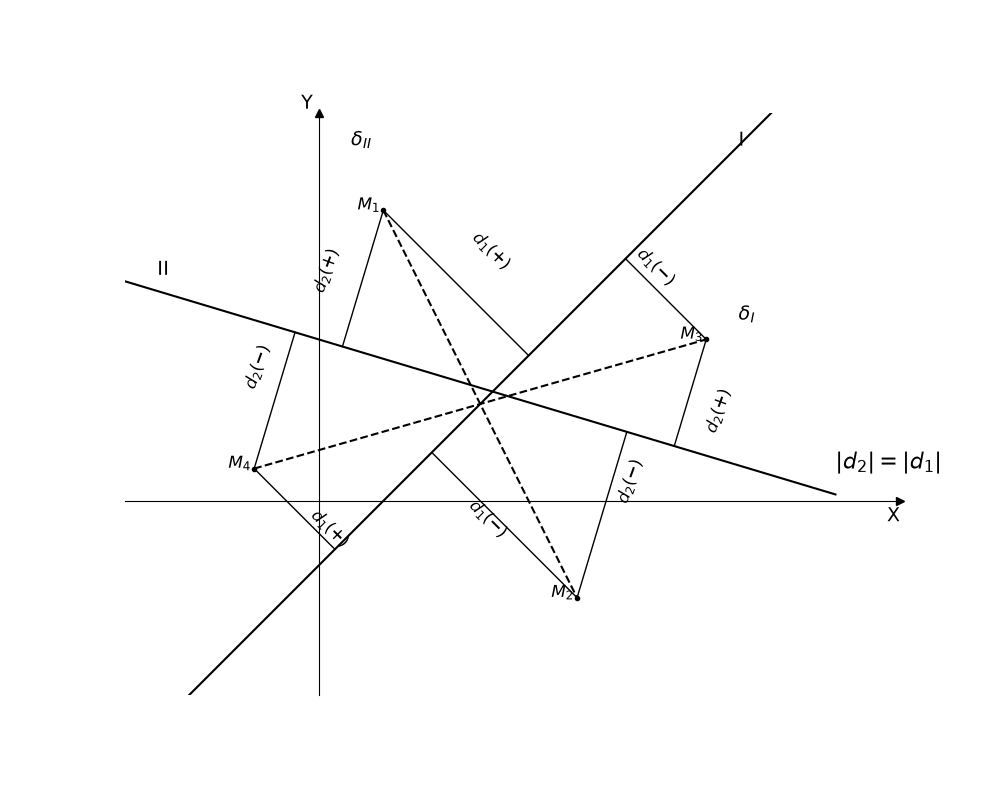
VIII (b).Bisectors of the Angles Between Lines
The choice of sign is made according to the figure: a point on a bisector is equidistant from both lines, \(|d_1|=|d_2|\).
IX.Pencil of Lines
If two intersecting lines are given by the equations \(A_1x+B_1y+C_1=0\) and \(A_2x+B_2y+C_2=0\), then the equation
defines a line passing through the point of intersection of the given lines. Here \(\lambda\) is a numerical parameter. The set of all values of \(\lambda\) defines the pencil of lines, whose centre is the point of intersection of the given lines.
Basic Definitions
The core formulas for planes and straight lines in space — the tools used throughout the problems below.
I (a).General Equation of a Plane
Every equation of the first degree with respect to the coordinates of a point in space, \(Ax+By+Cz+D=0\), defines a plane; conversely, every plane can be described by an equation of the first degree. Here \(A,\,B,\,C\) are the coordinates of the normal vector:
I (b).Condition for a Point to Lie on a Plane
A point \(M_0(x_0,y_0,z_0)\) lies on the plane \(A_1x+B_1y+C_1z+D_1=0\) precisely when its coordinates satisfy the equation:
II.Normal Equation of a Plane
The normal equation of a plane has the form
where \(\cos\alpha,\,\cos\beta,\,\cos\gamma\) are the direction cosines of the normal and \(p\) is the distance from the origin to the plane:
This equation is obtained from the general equation \(Ax+By+Cz+D=0\) by multiplying both sides by the normalising factor \(\mu=\pm\dfrac{1}{\sqrt{A^2+B^2+C^2}}\). The sign of the normalising factor is taken opposite to the sign of the free term \(D\) of the general equation.
III (a).Equation of a Plane in Intercept Form
The intercept form of the equation of a plane is
where \(a=-\dfrac{D}{A}\), \(b=-\dfrac{D}{B}\), \(c=-\dfrac{D}{C}\). The numbers \(a,\,b,\,c\) are respectively the abscissa, ordinate, and applicate (the \(x\)-, \(y\)- and \(z\)-intercepts) of the points where the plane meets the coordinate axes.
III (b).Plane Through a Point, Perpendicular to a Vector
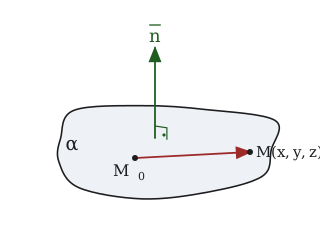
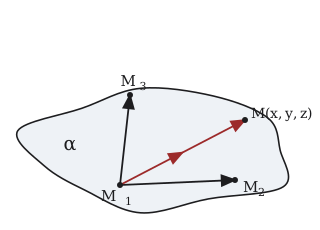
The equation of the plane passing through the point \(M_0(x_0,y_0,z_0)\) and perpendicular to the vector \(\overline{n}=A\overline{i}+B\overline{j}+C\overline{k}\) has the form
or, in vector form, \(\bigl(\overline{n},\,\overline{M_0M}\bigr)=0\).
III (c).Plane Through Three Points
The equation of the plane passing through three given points \(M_1(x_1,y_1,z_1)\), \(M_2(x_2,y_2,z_2)\), \(M_3(x_3,y_3,z_3)\) has the form
or, in vector form, as the vanishing of the scalar triple product \(\bigl(\overline{M_1M_2},\;\overline{M_1M_3},\;\overline{M_1M}\bigr)=0\).
III (d).Pencil of Planes
For an arbitrary value of the parameter \(\lambda\), the equation
defines a plane passing through the line of intersection of the planes
III (e).Condition for a Point to Lie on a Plane of the Pencil
The condition for a point \(M_0(x_0,y_0,z_0)\) to lie on a plane belonging to the pencil has the form
From this we find the corresponding value \(\lambda_{M_0}\):
III (f).Plane Through a Point and a Line
The equation of the plane passing through the point \(M_0(x_0,y_0,z_0)\) and the line defined as the intersection of the two planes \(A_1x+B_1y+C_1z+D_1=0\) and \(A_2x+B_2y+C_2z+D_2=0\) has the form
IV.Angle Between Two Planes
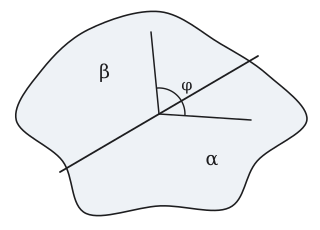
The angle \(\varphi\) between the planes \(A_1x+B_1y+C_1z+D_1=0\) and \(A_2x+B_2y+C_2z+D_2=0\) is determined by the formula
The planes are parallel when
perpendicular when
and intersecting when
V.Deviation of a Point from a Plane
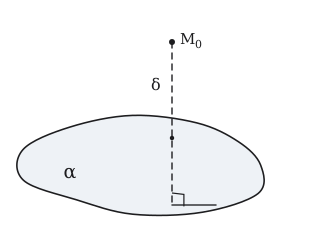
The deviation \(\delta\) of a point \(M_0(x_0,y_0,z_0)\) from the plane \(Ax+By+Cz+D=0\) is found by the formula
where the sign before the radical is taken opposite to the sign of the free term \(D\). The distance from the point \(M_0\) to the plane equals \(d=|\delta|\).
VI (a).Line Through Two Points
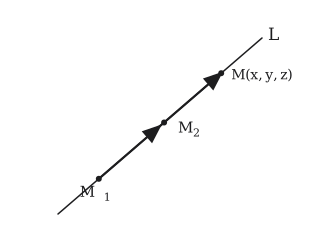
The equation of the straight line passing through two points \(M_1(x_1,y_1,z_1)\) and \(M_2(x_2,y_2,z_2)\) has the form
or, in vector form,
where \(\overline{M_1M}=(x-x_1,\,y-y_1,\,z-z_1)\) and \(\overline{M_1M_2}=(x_2-x_1,\,y_2-y_1,\,z_2-z_1)\).
VI (b).Canonical Equation of a Line
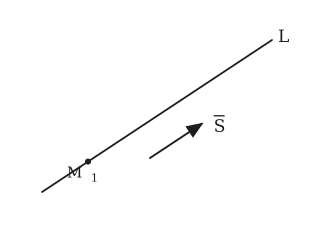
The equation of the straight line passing through the point \(M_1(x_1,y_1,z_1)\) parallel to the vector \(\overline{S}=l\overline{i}+m\overline{j}+n\overline{k}\) has the form
This is the canonical equation of the line; the vector \(\overline{S}\) is called the direction vector of the line \(L\).
VI (c).Parametric Equation of a Line
The parametric equation of a straight line is
It is obtained from the canonical equation by introducing the parameter \(t\): setting \(\dfrac{x-x_1}{l}=\dfrac{y-y_1}{m}=\dfrac{z-z_1}{n}=t\) and solving each ratio for the corresponding coordinate.
VI (d).Line as the Intersection of Two Planes
A straight line in space can be defined by the equations of two planes:
This is the general equation of a straight line. To bring it to canonical form:
1) Find a point \(M\) on the line by fixing one of the coordinates (say \(z=z_0\)) and solving the system for the remaining two:
2) Find the direction vector \(\overline{S}\), parallel to the line (\(\overline{S}\perp\overline{n}_1\) and \(\overline{S}\perp\overline{n}_2\)), as the cross product
Hence \(\dfrac{x-x_0}{l}=\dfrac{y-y_0}{m}=\dfrac{z-z_0}{n}\) — the canonical form of the line.
VI (e).From Canonical Form to Two Planes
If a line is given by the canonical equation \(\dfrac{x-x_0}{l}=\dfrac{y-y_0}{m}=\dfrac{z-z_0}{n}\), then the pair of equations
defines the same line as the intersection of two planes.
VI (f).Angle Between Two Lines
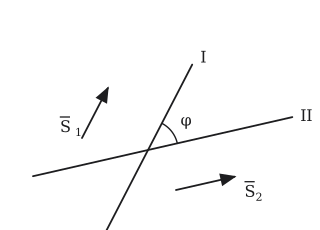
The angle between two lines in space, given by their canonical equations \(\dfrac{x-x_1}{l_1}=\dfrac{y-y_1}{m_1}=\dfrac{z-z_1}{n_1}\) and \(\dfrac{x-x_2}{l_2}=\dfrac{y-y_2}{m_2}=\dfrac{z-z_2}{n_2}\), is determined by the formula
where \(\overline{S}_1=(l_1,m_1,n_1)\) and \(\overline{S}_2=(l_2,m_2,n_2)\). The lines are parallel when
and perpendicular when
VI (g).Condition for Two Lines to be Coplanar
Two lines given by their canonical equations \(\dfrac{x-x_1}{l_1}=\dfrac{y-y_1}{m_1}=\dfrac{z-z_1}{n_1}\) and \(\dfrac{x-x_2}{l_2}=\dfrac{y-y_2}{m_2}=\dfrac{z-z_2}{n_2}\) are coplanar if and only if
If the numbers \(l_1,m_1,n_1\) are not proportional to \(l_2,m_2,n_2\), this coplanarity condition is the necessary and sufficient condition for the two lines to intersect.
VII.Angle Between a Line and a Plane
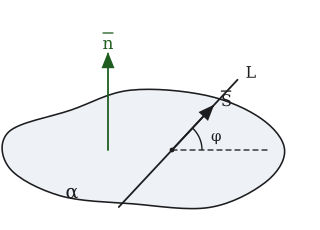
The angle between a line \(\dfrac{x-x_1}{l}=\dfrac{y-y_1}{m}=\dfrac{z-z_1}{n}\) and a plane \(Ax+By+Cz+D=0\) is determined by the formula
where \(\overline{S}=\{l,m,n\}\) and \(\overline{n}=\{A,B,C\}\). The line is parallel to the plane when
and perpendicular to the plane when
VIII.Point of Intersection of a Line and a Plane
To find the point of intersection of a line \(\dfrac{x-x_0}{l}=\dfrac{y-y_0}{m}=\dfrac{z-z_0}{n}\) with a plane \(Ax+By+Cz+D=0\), write the line in parametric form
and substitute into the equation of the plane. From it we determine the parameter \(t\):
Substituting this value back into the parametric equations gives the coordinates \(x,\,y,\,z\) of the intersection point.
- If \(Al+Bm+Cn\neq0\), the line intersects the plane.
- If \(Al+Bm+Cn=0\) and \(Ax_0+By_0+Cz_0+D\neq0\), the line is parallel to the plane.
- If \(Al+Bm+Cn=0\) and \(Ax_0+By_0+Cz_0+D=0\), the line lies in the plane.
Basic Definitions
The core operations on vectors given by coordinates — sums and length, the scalar, vector and mixed products, and projection onto an axis — the tools used throughout the problems below.
I.1.Coordinates of a Vector
If a vector \(\overline{a}\) has Cartesian rectangular coordinates \(x,\,y,\,z\), then
If a vector \(\overline{AB}\) is given by its initial point \(A(x_1,y_1,z_1)\) and terminal point \(B(x_2,y_2,z_2)\), then the coordinates of this vector \(\overline{AB}=\{x,y,z\}\) equal the differences of the like coordinates of the end and the start:
The zero vector is a vector whose start and end coincide (it has an arbitrary direction).
I.2.Sum and Difference of Vectors
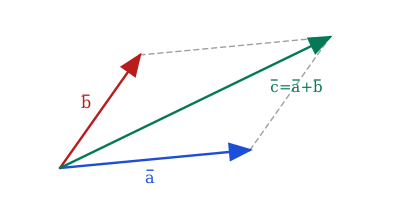
Sum. The sum of two vectors is built either by the triangle rule (place them head to tail) or by the parallelogram rule (draw them from a common origin).
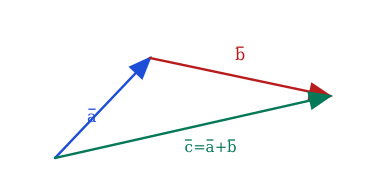
Difference. The difference \(\overline{c}=\overline{a}-\overline{b}\) is the other diagonal of the parallelogram built on \(\overline{a}\) and \(\overline{b}\).
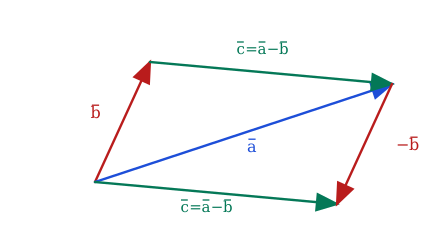
If \(\overline{a}=\{x_1,y_1,z_1\}\) and \(\overline{b}=\{x_2,y_2,z_2\}\), then
If \(\overline{a}=\{x_1,y_1,z_1\}\) and \(\lambda=\text{const}\), then
I.3.Length of a Vector
If \(\overline{a}=\{x,y,z\}\), the length of the vector in an orthonormal basis is
Since
we have \(\cos^2\alpha+\cos^2\beta+\cos^2\gamma=1\). The direction cosines of a vector are the coordinates of its ort (unit vector):
I.4.Scalar Product of Vectors
Definition. The scalar product of two vectors is the number equal to the product of their lengths and the cosine of the angle between them:
Properties of the scalar product:
- \(\overline{a}\cdot\overline{b}=\overline{b}\cdot\overline{a}\) — commutativity;
- \((\lambda\overline{a})\cdot\overline{b}=\lambda(\overline{a}\,\overline{b})\) — associativity;
- \(\overline{a}(\overline{b}+\overline{c})=\overline{a}\,\overline{b}+\overline{a}\,\overline{c}\) — distributivity;
- \(\overline{a}\cdot\overline{b}=0\Leftrightarrow\overline{a}\perp\overline{b}\), or \(\overline{a}=0\), or \(\overline{b}=0\);
- \(\overline{a}\cdot\overline{a}=|\overline{a}|^2\Rightarrow|\overline{a}|=\sqrt{\overline{a}\cdot\overline{a}}\).
If \(\overline{a}=\{x_1,y_1,z_1\}\) and \(\overline{b}=\{x_2,y_2,z_2\}\), then
I.4 (a).Length of \(\overline{a}=\alpha\overline{m}+\beta\overline{n}\)
If \(\overline{a}=\alpha\overline{m}+\beta\overline{n}\), where \(|\overline{m}|,\,|\overline{n}|\) and the angle \(\widehat{\overline{m},\overline{n}}\) between the vectors are known and \(\alpha,\beta=\text{const}\), then
I.4 (b).Scalar Product of Two Combinations
If \(\overline{a}=\alpha\overline{m}+\beta\overline{n}\) and \(\overline{b}=l\overline{m}+d\overline{n}\), where \(|\overline{m}|,\,|\overline{n}|\) and the angle \(\widehat{\overline{m},\overline{n}}\) are known and \(\alpha,\beta,l,d=\text{const}\), then
I.4 (c).Angle Between Two Vectors
The angle \(\varphi\) between vectors \(\overline{a}\) and \(\overline{b}\) is computed by the formula
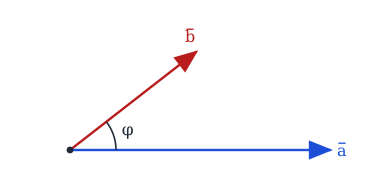
I.4 (d).Angle Between Two Vectors in Coordinates
If \(\overline{a}=\{x_1,y_1,z_1\}\) and \(\overline{b}=\{x_2,y_2,z_2\}\), then
I.5.Vector Product of Vectors
Definition. The vector product of a vector \(\overline{a}\) by a vector \(\overline{b}\) is the vector \(\overline{c}\) satisfying the following conditions:
- \(|\overline{c}|=|\overline{a}|\cdot|\overline{b}|\sin\bigl(\widehat{\overline{a},\overline{b}}\bigr)\);
- \(\overline{c}\perp\overline{a},\ \overline{c}\perp\overline{b}\);
- the vector \(\overline{c}\) is directed so that, seen from its end, the shortest rotation from \(\overline{a}\) to \(\overline{b}\) is counterclockwise.
The vector product is denoted \(\overline{a}\times\overline{b}\) or \([\overline{a}\cdot\overline{b}]\).
Properties of the vector product:
- \(\overline{a}\times\overline{b}=-\,\overline{b}\times\overline{a}\) — anticommutative;
- \(\overline{a}\times\overline{b}=0\) if \(\overline{a}=0\) or \(\overline{b}=0\), or \(\overline{a}\parallel\overline{b}\);
- \((\lambda\overline{a})\times\overline{b}=\overline{a}\times(\lambda\overline{b})=\lambda(\overline{a}\times\overline{b})\) — the scalar factor may be taken outside;
- \(\overline{a}\times(\overline{b}+\overline{c})=\overline{a}\times\overline{b}+\overline{a}\times\overline{c}\) — distributive over addition.
If \(\overline{a}=\{x_1,y_1,z_1\}\) and \(\overline{b}=\{x_2,y_2,z_2\}\), then
I.5 (a).Area of a Triangle
The area of the triangle built on the vectors \(\overline{a}=\{x_1,y_1,z_1\}\) and \(\overline{b}=\{x_2,y_2,z_2\}\) is computed by the formula
I.5 (b).Vector Product of Two Combinations · Area of a Parallelogram
If \(\overline{a}=\alpha\overline{m}+\beta\overline{n}\) and \(\overline{b}=l\overline{m}+d\overline{n}\), where \(\alpha,\beta,l,d=\text{const}\), then
since \([\overline{m},\overline{n}]=-[\overline{n},\overline{m}]\); \([\overline{m},\overline{m}]=0\); \([\overline{n},\overline{n}]=0\). The area of the parallelogram is
I.5 (c).A Vector Perpendicular to Two Vectors
If \(\overline{a}=\{x_1,y_1,z_1\}\), \(\overline{b}=\{x_2,y_2,z_2\}\) and \(\overline{c}\perp\overline{a},\ \overline{c}\perp\overline{b}\), then
or
where
I.6.Mixed Product of Three Vectors
Definition. The mixed product of vectors \(\overline{a},\overline{b}\) and \(\overline{c}\) is the scalar product of the vector \(\overline{a}\times\overline{b}\) with the vector \(\overline{c}\), i.e. \((\overline{a}\times\overline{b})\cdot\overline{c}\).
Properties of the mixed product:
- The mixed product equals zero if: (a) at least one of the factors is zero; (b) two of the factors are collinear (lie on parallel lines); (c) the three nonzero vectors are parallel to one and the same plane (coplanarity).
- The mixed product does not change if the signs of the vector \((\times)\) and scalar \((\cdot)\) products are interchanged, i.e. \((\overline{a}\times\overline{b})\cdot\overline{c}=\overline{a}\cdot(\overline{b}\times\overline{c})\); it is therefore written simply \(\overline{a}\,\overline{b}\,\overline{c}\).
- It does not change under a cyclic permutation of the vectors: \(\overline{a}\,\overline{b}\,\overline{c}=\overline{b}\,\overline{c}\,\overline{a}=\overline{c}\,\overline{a}\,\overline{b}\).
- Swapping any two vectors changes only its sign: \(\overline{b}\,\overline{a}\,\overline{c}=-\overline{a}\,\overline{b}\,\overline{c};\ \ \overline{c}\,\overline{b}\,\overline{a}=-\overline{a}\,\overline{b}\,\overline{c};\ \ \overline{a}\,\overline{c}\,\overline{b}=-\overline{a}\,\overline{b}\,\overline{c}.\)
If \(\overline{a}=\{x_1,y_1,z_1\}\); \(\overline{b}=\{x_2,y_2,z_2\}\); \(\overline{c}=\{x_3,y_3,z_3\}\), then
From these properties it follows that:
(a) the necessary and sufficient condition for the coplanarity of three vectors is \(\overline{a}\,\overline{b}\,\overline{c}=0\), i.e.
(b) the volume \(V_1\) of the parallelepiped built on \(\overline{a},\overline{b},\overline{c}\) and the volume \(V_2\) of the triangular pyramid (tetrahedron) they form are found by the formulas \(V_1=\bigl|\overline{a}\,\overline{b}\,\overline{c}\bigr|\), or
or
I.7.Projection of a Vector \(\overline{AB}\) onto an Axis \(l\)
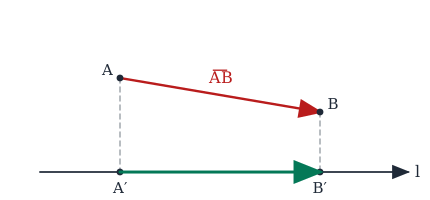
The projection of a vector \(\overline{AB}\) onto an axis \(l\) is the value of the directed segment \(A'B'\) enclosed between the projections of the start and the end of \(\overline{AB}\), taken with a positive sign when \(\overline{A'B'}\) has the direction of the ort of the axis \(l\), and with a negative sign when \(\overline{A'B'}\) and the ort have opposite directions:
Basic Definitions
The definitions, canonical equations, parameters and construction rules for the ellipse, hyperbola and parabola — the tools used throughout the problems below.
Necessary Information
On the topic “Curves of the Second Order” you should know:
- the definitions of the ellipse, the hyperbola and the parabola;
- the canonical equations of these curves;
- the geometric meaning of the parameters entering the equations, and the relations between the parameters,
and be able to:
- determine the type of a curve from its equation;
- derive the canonical equations of second-order curves;
- find the coordinates of the foci and the other parameters of the curves, and construct the curve.
I.Definition and Canonical Equation
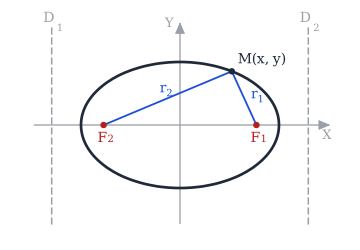
Definition. An ellipse is the set of points of the plane, the sum of whose distances to two given points — called the foci \(F_1\) and \(F_2\) — is a constant (denoted by \(2a\)). Moreover this constant is greater than the distance between the foci.
If the coordinate axes are placed relative to the ellipse as shown in Fig. 1, and the foci lie on the \(Ox\) axis at equal distances from the origin at the points \(F_1(c;0)\), \(F_2(-c;0)\), one obtains the simplest (canonical) equation of the ellipse:
where \(a\) is the semi-major and \(b\) the semi-minor axis of the ellipse, and \(a,\,b\) and \(c\) (\(c\) is half the distance between the foci) are related by \(a^2=b^2+c^2\).
The shape of the ellipse (its measure of “flattening”) is characterised by its eccentricity: \(\varepsilon=\dfrac{c}{a}\) (since \(c<a\), we have \(\varepsilon<1\)).
The lines \(D_1:\ x=-\dfrac{a}{\varepsilon}\) and \(D_2:\ x=+\dfrac{a}{\varepsilon}\), perpendicular to the major axis and passing at distance \(\dfrac{a}{\varepsilon}\) from the centre, are called the directrices of the ellipse.
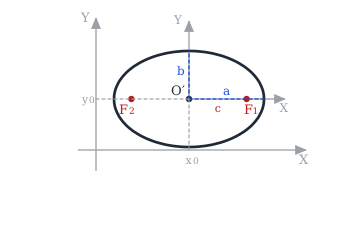
I.1.Location of the Ellipse and Its Parameters
1) \(a>b,\ c=\sqrt{a^2-b^2},\ F_1(x_0+c;\,y_0),\ F_2(x_0-c;\,y_0)\);
2) \(a<b,\ c=\sqrt{b^2-a^2},\ F_1(x_0;\,y_0+c),\ F_2(x_0;\,y_0-c)\).
I.2.Eccentricity
1) \(a>b;\ \varepsilon=\dfrac{c}{a}=\dfrac{\sqrt{a^2-b^2}}{a}\) — eccentricity;
2) \(a<b;\ \varepsilon=\dfrac{c}{b}=\dfrac{\sqrt{b^2-a^2}}{b}\) — eccentricity.
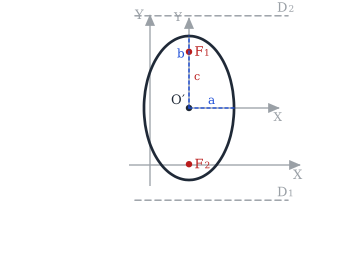
I.3.Equations of the Directrices
1) \(a>b\): \(\quad D_2:\ x=x_0+\dfrac{a}{\varepsilon};\qquad D_1:\ x=x_0-\dfrac{a}{\varepsilon}\);
2) \(b>a\): \(\quad D_2:\ y=y_0+\dfrac{b}{\varepsilon};\qquad D_1:\ y=y_0-\dfrac{b}{\varepsilon}\).
II.Definition and Canonical Equation
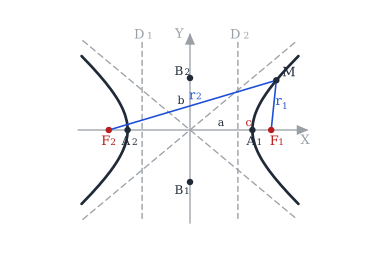
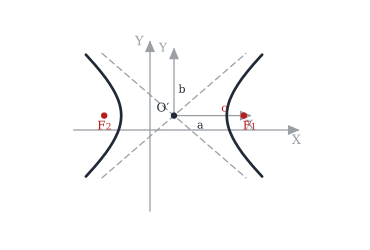
Definition. A hyperbola is the set of points of the plane, the absolute value of the difference of whose distances to two given points — called the foci — is a constant (denoted by \(2a\)); moreover this constant is less than the distance between the foci.
If the foci of the hyperbola are placed at the points \(F_1(c;0)\) and \(F_2(-c;0)\), one obtains the canonical equation of the hyperbola
The points \(A_1(a;0)\) and \(A_2(-a;0)\) are called the vertices of the hyperbola. The segment \(A_1A_2\) with \(|A_1A_2|=2a\) is called the real (transverse) axis of the hyperbola, and the segment \(B_1B_2\) with \(|B_1B_2|=2b\) the imaginary axis.
The hyperbola has two asymptotes, whose equations are
The ratio \(\varepsilon=\dfrac{c}{a}>1\) is called the eccentricity of the hyperbola.
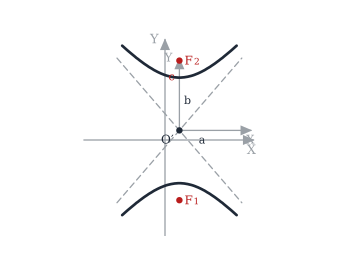
The equation \(\dfrac{y^2}{b^2}-\dfrac{x^2}{a^2}=1\) is also an equation of a hyperbola, but the real axis of this hyperbola is the segment of the \(Oy\) axis of length \(2b\).
The two hyperbolas \(\dfrac{x^2}{a^2}-\dfrac{y^2}{b^2}=1\) and \(\dfrac{y^2}{b^2}-\dfrac{x^2}{a^2}=1\) have the same semi-axes and the same asymptotes, but the real axis of one serves as the imaginary axis of the other and vice versa. Such two hyperbolas are called conjugate.
The lines \(D_1:\ x=-\dfrac{a}{\varepsilon}\) and \(D_2:\ x=+\dfrac{a}{\varepsilon}\), perpendicular to the real axis and passing at distance \(\dfrac{a}{\varepsilon}\) from the centre, are called the directrices of the hyperbola.
II.1.Location of the Hyperbola
1) \(\dfrac{(x-x_0)^2}{a^2}-\dfrac{(y-y_0)^2}{b^2}=1;\ O'(x_0;y_0)\) — centre, \(c=\sqrt{a^2+b^2}\), \(F_1(x_0+c;\,y_0)\), \(F_2(x_0-c;\,y_0)\) (Fig. 5);
2) \(\dfrac{(y-y_0)^2}{b^2}-\dfrac{(x-x_0)^2}{a^2}=1;\ O'(x_0;\,y_0)\) — centre, \(c=\sqrt{a^2+b^2}\), \(F_1(x_0;\,y_0-c)\), \(F_2(x_0;\,y_0+c)\) (Fig. 6).
II.2.Eccentricity
1) \(\dfrac{(x-x_0)^2}{a^2}-\dfrac{(y-y_0)^2}{b^2}=1;\ \varepsilon=\dfrac{c}{a}=\dfrac{\sqrt{a^2+b^2}}{a}\) — eccentricity.
2) \(\dfrac{(y-y_0)^2}{b^2}-\dfrac{(x-x_0)^2}{a^2}=1;\ \varepsilon=\dfrac{c}{b}=\dfrac{\sqrt{a^2+b^2}}{b}\) — eccentricity.
II.3.Equations of the Directrices of the Hyperbola
1) \(\dfrac{(x-x_0)^2}{a^2}-\dfrac{(y-y_0)^2}{b^2}=1,\)
2) \(\dfrac{(y-y_0)^2}{b^2}-\dfrac{(x-x_0)^2}{a^2}=1,\)
II.4.Equation of the Asymptotes
III.Definition and Canonical Equation
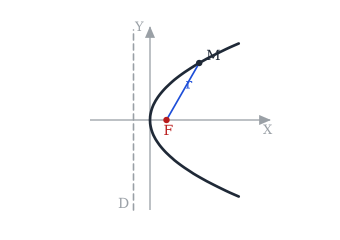
Definition. A parabola is the set of points of the plane equidistant from a given point — called the focus — and a given line — called the directrix.
If the directrix of the parabola is the line \(D:\ x=-\dfrac{p}{2}\), and the focus is the point \(F\left(\dfrac{p}{2};\,0\right)\), then the equation of the parabola has the form
III.1.Location of the Parabola and Its Parameters
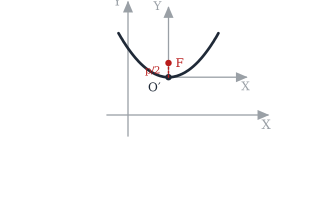
1) \((x-x_0)^2=2p(y-y_0);\ O'(x_0,y_0)\) — vertex, \(p>0,\ F(x_0,\,y_0+\tfrac{p}{2})\) (Fig. 8) or \(p<0,\ F(x_0,\,y_0+\tfrac{p}{2})\) (Fig. 9).
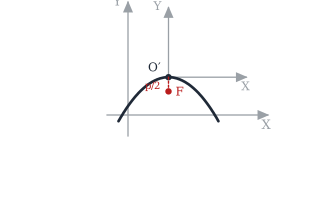
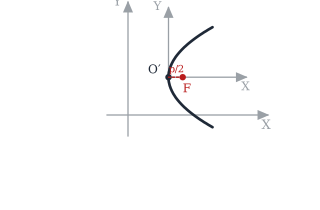
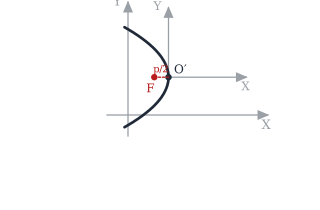
2) \((y-y_0)^2=2p(x-x_0);\ O'(x_0,y_0)\) — vertex, \(p>0,\ F(x_0+\tfrac{p}{2},\,y_0)\) (Fig. 10) or \(p<0,\ F(x_0+\tfrac{p}{2},\,y_0)\) (Fig. 11).
III.2.Equation of the Directrix of the Parabola
1) \((x-x_0)^2=2p(y-y_0),\)
2) \((y-y_0)^2=2p(x-x_0),\)
IV.1.Type from the Product \(A\cdot C\)
For the investigation of second-order curves, whose general equation has the form \(Ax^2+Cy^2+2Dx+2Ey+F=0\), one considers the product \(A\cdot C\):
- if \(A\cdot C>0\), we have an ellipse;
- if \(A\cdot C<0\), we have a hyperbola;
- if \(A\cdot C=0\), we have a parabola.
IV.2.Completing the Square
In the investigation of second-order curves whose equation is written in general form, the “procedure of completing the square” is useful. Completing the square of the equation \(Ax^2+Cy^2+2Dx+2Ey+F=0\), we obtain
or
Denote: \(x_0=-\dfrac{D}{A},\ y_0=-\dfrac{E}{C}\),
IV.2 (a).Elliptic Type \((A\cdot C>0)\)
If \(A\cdot C>0\), the equation defines a curve of elliptic type. Moreover:
a) if \(\dfrac{D^2}{A}+\dfrac{E^2}{C}-F<0\), we have an imaginary ellipse;
b) if \(\dfrac{D^2}{A}+\dfrac{E^2}{C}-F=0\), we have the point \(\left(-\dfrac{D}{A};\,-\dfrac{E}{C}\right)\);
c) if \(\dfrac{D^2}{A}+\dfrac{E^2}{C}-F>0\), then
and we have the canonical form of an ellipse.
IV.2 (b).Hyperbolic Type \((A\cdot C<0)\)
If \(A\cdot C<0\), the equation defines a curve of hyperbolic type. Moreover:
a) if \(\dfrac{D^2}{A}+\dfrac{E^2}{C}-F>0\) or \(\dfrac{D^2}{A}+\dfrac{E^2}{C}-F<0\), then
i.e. the canonical form of a hyperbola;
b) if \(\dfrac{D^2}{A}+\dfrac{E^2}{C}-F=0\), then, taking the signs of \(A\) and \(C\) into account, we have \(y-y_0=\pm\dfrac{b}{a}(x-x_0)\), i.e. a pair of intersecting lines.
IV.2 (c).Parabolic Type
a) If \(C=0\), the general equation \(Ax^2+Cy^2+2Dx+2Ey+F=0\) defines a curve of parabolic type. Completing the square, we have:
Denote \(x_0=-\dfrac{D}{A},\ y_0=-\dfrac{F-\dfrac{D^2}{A}}{2E},\ p=-\dfrac{E}{A}\). Then \((x-x_0)^2=2p(y-y_0)\), i.e. the canonical form of a parabola;
b) if \(A=0\), then \(Ax^2+Cy^2+2Dx+2Ey+F=0\), i.e. a curve of parabolic type. Completing the square, we have:
Denote \(x_0=-\dfrac{F-\dfrac{E^2}{C}}{2D},\ y_0=-\dfrac{E}{C},\ p=-\dfrac{D}{C}\). Then \((y-y_0)^2=2p(x-x_0)\), i.e. the canonical form of a parabola.
V.1.Equations of the Form \(y=b+\sqrt{ax^2+cx+d}\)
Consider an equation of the form \(y=b+\sqrt{ax^2+cx+d}\). This equation is equivalent to the system
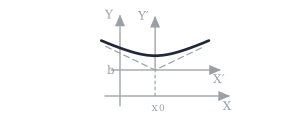
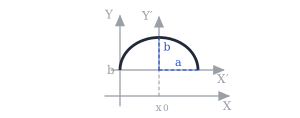
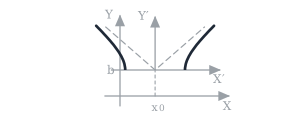
V.1 (a). If \(d-\dfrac{c^2}{4a}>0\) and \(a>0\), the equation \((y-b)^2-a\left(x+\tfrac{c}{2a}\right)^2=d-\tfrac{c^2}{4a}\) defines the part of a hyperbola lying in the half-plane \(y\ge b\) (Fig. 12). We construct the part of the hyperbola above the line \(y=b\).
V.1 (b). If \(d-\dfrac{c^2}{4a}>0\) and \(a<0\), the equation defines the part of an ellipse lying in the half-plane \(y\ge b\) (Fig. 13). We construct the part of the ellipse above the line \(y=b\).
V.1 (c). If \(d-\dfrac{c^2}{4a}<0\) and \(a>0\), the equation defines the part of a hyperbola lying in the half-plane \(y\ge b\) (Fig. 14).
V.1 (d). If \(d-\dfrac{c^2}{4a}<0\) and \(a<0\), the equation defines an imaginary ellipse.
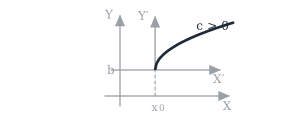
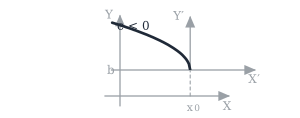
V.1 (e). If \(a=0\), the equation \(y=b+\sqrt{cx+d}\) is equivalent to the system \(\begin{cases}y-b\ge 0\\ (y-b)^2=c\left(x+\tfrac{d}{c}\right)\end{cases}\), which defines the part of a parabola lying in the half-plane \(y\ge b\) (Figs. 15, 16).
V.1 (f). If \(d-\dfrac{c^2}{4a}=0\) and \(a>0\), the equation defines a pair of intersecting lines \(y-b=\pm\sqrt{a}\left(x+\tfrac{c}{2a}\right)\), which lie in the half-plane \(y\ge b\).
V.1 (g). If \(d-\dfrac{c^2}{4a}=0\) and \(a<0\), the equation defines the point \(\left(-\tfrac{c}{2a};\,b\right)\), provided it lies in the half-plane \(y\ge b\).
V.2.Equations of the Form \(y=b-\sqrt{ax^2+cx+d}\)
Consider an equation of the form \(y=b-\sqrt{ax^2+cx+d}\). This equation is equivalent to the system
since only positive values of the root are considered.
V.2 (a). If \(d-\dfrac{c^2}{4a}>0\) and \(a>0\), the equation defines the part of a hyperbola lying in the half-plane \(y\le b\) (Fig. 17).
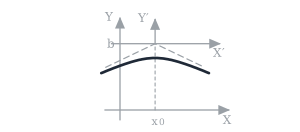
V.2 (b). If \(d-\dfrac{c^2}{4a}>0\) and \(a<0\), the equation defines the part of an ellipse lying in the half-plane \(y\le b\) (Fig. 18).
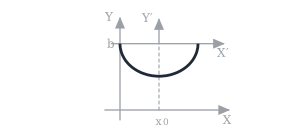
V.2 (c). If \(d-\dfrac{c^2}{4a}<0\) and \(a>0\), the equation defines the part of a hyperbola lying in the half-plane \(y\le b\) (Fig. 19).
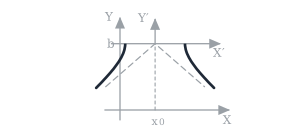
V.2 (d). If \(d-\dfrac{c^2}{4a}<0\) and \(a<0\), the equation defines an imaginary ellipse.
V.2 (e). If \(a=0\), the equation \(y=b-\sqrt{cx+d}\) is equivalent to the system \(\begin{cases}y\le b\\ (y-b)^2=c\left(x+\tfrac{d}{c}\right)\end{cases}\), which defines the part of a parabola lying in the half-plane \(y\le b\) (Figs. 20, 21).
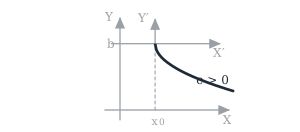
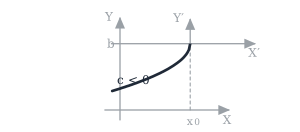
V.2 (f). If \(d-\dfrac{c^2}{4a}=0\) and \(a>0\), the equation defines a pair of intersecting lines \(y-b=\pm\sqrt{a}\left(x+\tfrac{c}{2a}\right)\), which lie in the half-plane \(y\le b\).
V.2 (g). If \(d-\dfrac{c^2}{4a}=0\) and \(a<0\), the equation defines the point \(\left(-\tfrac{c}{2a};\,b\right)\), provided it lies in the half-plane \(y\le b\).
General Equation of a Line
Find the general equation of line BC, given B(−2, −1) and C(4, 3).
Problem Solved!
Lines & Equal Distances
Equation of a line · distance from a point to a line · angle between two lines — with one subtle case the obvious method misses.
Calculate the angle between lines a and b, both passing through A(1, 3) and equally distant from B(−2, −1) and C(4, 3).
Before you compute — think
Algorithm A writes the unknown line as y−3 = k(x−1) and sets the distance from B equal to the distance from C. The whole equation is built around the slope k.
Hint: what kind of line through A has no slope k at all? Could the distance equation ever produce it?
Why Symmetry Works
Before we solve step by step, here is the geometric insight behind Algorithm B.
Key insight: two cases of equidistance
Problem Solved!
The Perpendicular from a Point to a Line
Equation of a line · slope of a line · the perpendicularity condition for slopes.
On the plane three points are given: A(1, 3), B(−2, −1), C(4, 3). Write the general equation of the perpendicular AD, dropped from point A onto line BC.
Before you compute — think
Algorithm B step 1 says "find a vector parallel to AD" — but that is a goal, not an instruction. It never says how.
Hint: a valid algorithm is a list of explicit, elementary steps a person (or computer) can follow blindly. Which sub-steps does "find a parallel vector" quietly leave out?
Perpendicular Means Negative-Reciprocal Slopes
Before solving step by step, here is the idea Algorithm A is built on.
Key insight: the perpendicularity condition
Problem Solved!
Bisectors of the Angles Between Two Lines
Equation of a line · perpendicular slopes · the angle-bisector formula.
On the plane three points are given: A(1, 3), B(−2, −1), C(4, 3). Write the equations of the bisectors of the angles formed by lines BC and AD. The lines are perpendicular.
Before you compute — think
Algorithm B step 2 says "find a vector perpendicular to BC" — but that is a goal, not an instruction. It never says how.
Hint: a valid algorithm lists explicit, elementary steps a person (or computer) can follow blindly. What method does "find a perpendicular vector" quietly assume you already know?
From the Perpendicular to its Bisectors
Before solving step by step, here are the two ideas Algorithm A rests on.
Key insight
Problem Solved!
Lines Equidistant from Two Points
Equation of a line · parallel lines · midpoint of a segment — find both lines through a point that are equally far from two others.
On the plane three points are given: A(1, 3), B(−2, −1), C(4, 3). Write the equations of lines a and b, passing through point A and equally distant from points B and C.
Before you compute — think
Algorithm B jumps from the midpoint E straight to line a. But line a must be parallel to BC — and writing it needs the slope of BC.
Hint: which step of Algorithm B ever finds the direction (slope) of BC? If none does, can line a be written at all?
Two Ways to Be Equidistant
Before solving step by step, here is the geometric idea behind Algorithm A.
Key insight: two cases of equidistance
Problem Solved!
Analytic Geometry in the Plane
Focused on two-dimensional space, this section covers the geometric properties of lines in a coordinate plane. It explains how to find the coordinates of a point that divides a line segment in a given ratio, explores the various forms of linear equations, and demonstrates how to calculate the shortest distance from a point to a line.
Analytic Geometry in Space
Extends the methods of plane geometry into three dimensions. Covers the equations of planes and straight lines in space, distances from a point to a plane, and angles between geometric objects.
Vector Algebra
Works with vectors given by their coordinates in space. Covers the linear operations, the length and direction of a vector, and the three products — scalar, vector and mixed — used to find angles, areas, volumes and normals.
The Line of Intersection of Two Planes
Arrangement of two planes · direction vector of a line · canonical equations of a line in space.
Having verified that the planes α: 2x + 4y − 4z + 12 = 0 and β: x − 3y + z = 0 intersect, compose the canonical equations of their line of intersection (line a).
Before you compute — think
Algorithm B jumps straight to a direction vector — but it never checks that the two planes actually meet in a line.
Hint: if the planes were parallel or coincident there would be no line a at all. The problem itself says "having verified that the planes intersect". Which step does Algorithm B quietly skip?
A Line in Space Is a Point Plus a Direction
Before solving step by step, here is the idea Algorithm A is built on.
Key insight: a line is fixed by one point and one direction
Problem Solved!
The Perpendicular from a Point to a Plane
Normal of a plane · direction of a perpendicular · canonical equations of a line in space.
Write the canonical equations of the perpendicular AB dropped from the point A(1, 1, 0) onto the plane α: 2x + 4y − 4z + 12 = 0.
Before you compute — think
Algorithm B's first step is to find where AB meets α — but AB is precisely the line you're trying to construct.
Hint: you can't intersect a line with a plane before you have the line. Is finding the foot an instruction you can follow, or a result that already assumes the answer?
A Line Is a Point Plus a Direction
Before solving step by step, here is the idea Algorithm A is built on.
Key insight: the perpendicular is already pinned down
Problem Solved!
A Plane Perpendicular to Two Planes
Normals of planes · cross product · equation of a plane through a point.
Write the equation of the plane γ passing through the point A(1, 1, 0) and perpendicular to the two planes α: 2x + 4y − 4z + 12 = 0 and β: x − 3y + z = 0.
Before you compute — think
Algorithm B's step 2 says "find nγ from the perpendicularity conditions" — but that names a goal, not a procedure you can carry out.
Hint: written as conditions, nγ ⟂ nα and nγ ⟂ nβ are two equations in three unknowns. What single elementary operation actually produces a vector perpendicular to two given ones?
The Normal of γ Is Perpendicular to Both
Before solving step by step, here is the idea Algorithm A is built on.
Key insight: the cross product builds the normal of γ
Problem Solved!
A Plane Through a Point and a Line
Pencil of planes · fitting the parameter λ · equation of a plane.
Write the equation of the plane δ passing through the point A(1, 1, 0) and the line given as the intersection of the planes α: 2x + 4y − 4z + 12 = 0 and β: x − 3y + z = 0.
Before you compute — think
Algorithm B does reach the answer — but each of its lines is a whole procedure in disguise, not a single step.
Hint: "find the direction and a point of the line" is the entire Problem 1 (solve a system + a cross product); "find AM1 and the normal" is another cross product. Is there a route that skips building the line at all?
One Equation Sweeps Every Plane Through the Line
Before solving step by step, here is the idea Algorithm A is built on.
Key insight: the pencil turns about the line α ∩ β
Problem Solved!
The Distance from a Point to a Plane
Point-in-plane test · the distance formula in space.
Compute the distance d from the point A(1, 1, 0) to the plane 2x + 4y − 4z + 12 = 0.
Before you compute — think
Algorithm B does give the right distance — but it takes the long way, building the whole perpendicular and its foot just to measure one segment.
Hint: each of its three lines is a sub-problem on its own (a line, an intersection, a length). Is there a formula that returns the distance from the point and the plane directly?
One Formula Gives the Distance
Before solving step by step, here is the idea Algorithm A is built on.
Key insight: the distance is a single formula
Problem Solved!
The Angle Between an Edge and a Diagonal
Coordinates of vectors · lengths · scalar product · angle between vectors.
The parallelepiped ABCDA′B′C′D′ is built on the vectors AB(6, 2, 2), AD(1, 1, −1), AA′(−2, 3, 1). Compute the angle φ between edge A′D′ and diagonal DB′.
Algorithm B is invalid
Its last step reads sin φ from the scalar product — but by the definition in I.4 the scalar product equals |a||b| cos φ, so it can only give the cosine.
That step has no basis in the theory, so Algorithm B cannot reach the angle. (The sine would require the vector product, I.5.)
The Scalar Product Gives the Cosine
Before solving step by step, here is the idea Algorithm A is built on.
Key insight
Problem Solved!
The Area of a Triangular Section
Coordinates of vectors · vector product · area of a triangle.
The parallelepiped ABCDA′B′C′D′ is built on AB(6, 2, 2), AD(1, 1, −1), AA′(−2, 3, 1). Compute the area S of the section EB′C, where E is the midpoint of edge D′C′.
Algorithm B works — A is preferred here
By I.5 (a) the two sides may be taken from any common vertex of the triangle. Algorithm A uses C (CB′, CE); Algorithm B uses B′ (B′E, B′C). Their vector products have equal magnitude, so both give the same area.
So B is not wrong — same steps, same area. Algorithm A is preferred only because it works from vertex C, whose vectors CB′, CE (and CC′ = AA′) are reused in Problems 3 and 4. Since B reaches the answer with the same effort, it is marked amber (a hint), not an error.
Half a Vector Product Is a Triangle’s Area
Before solving step by step, here is the idea Algorithm A is built on.
Key insight
Problem Solved!
The Volume of a Tetrahedron
Coordinates of vectors · mixed product · volume of a tetrahedron.
The parallelepiped ABCDA′B′C′D′ is built on AB(6, 2, 2), AD(1, 1, −1), AA′(−2, 3, 1). Compute the volume of the tetrahedron EB′C′C, where E is the midpoint of edge D′C′.
Algorithm B is valid but inefficient
B builds the base area with a vector product (I.5), then the tetrahedron’s height, then combines them — three detours for what I.6 does in one step.
By I.6 (b) the volume is V = ⅙|CB′ × CE · CC′| directly. Algorithm A uses that.
The Mixed Product Is Six Volumes
Before solving step by step, here is the idea Algorithm A is built on.
Key insight
Problem Solved!
A Unit Normal to a Plane
Coordinates of vectors · vector product · unit normal vector.
The parallelepiped ABCDA′B′C′D′ is built on AB(6, 2, 2), AD(1, 1, −1), AA′(−2, 3, 1). Find the coordinates of the unit vector n₀ perpendicular to the plane B′CE, where E is the midpoint of edge D′C′.
Algorithm A is the step-by-step route
By I.5 (c) the normal can be formed from two sides of the plane drawn from any vertex. Algorithm A uses C (CB′, CE); Algorithm B uses B′ (B′C, B′E). Their products point opposite ways, but I.5 (c) fixes the unit normal only up to sign (±), so both give the same n₀.
The difference is the layout. Algorithm B merges two steps into one — it asks you to find the vector product and its length together. Algorithm A keeps them separate (find [CB′ × CE], then its length, then normalise), so each elementary step can be followed and checked on its own. That is why A is the route to use.
The Vector Product Points Across the Plane
Before solving step by step, here is the idea Algorithm A is built on.
Key insight
Problem Solved!
The Foot of a Perpendicular
Length · unit vector · scalar product · projection of a vector.
The parallelepiped ABCDA′B′C′D′ is built on AB(6, 2, 2), AD(1, 1, −1), AA′(−2, 3, 1). Find the coordinates of the vector AF, where F is the foot of the perpendicular dropped from point A′ onto edge AB.
Algorithm A is the efficient choice
Algorithm B first computes the length |AA′| and the cosine of the angle (I.4 (c)) — introducing square roots that cancel out in the final step.
Algorithm A skips all of that: by I.7 the projection is (AA′·AB)/|AB| straight from the dot product, and AF follows at once — no square roots. That is why A is the efficient route.
A Projection Lands the Foot of the Perpendicular
Before solving step by step, here is the idea Algorithm A is built on.
Key insight
Problem Solved!
Curves of the Second Order
Recognise and analyse the ellipse, hyperbola and parabola from a general second-degree equation. Determine the type from the product A·C, complete the square to reach the canonical form, and find the centre, foci, eccentricity, directrices, asymptotes — and construct the curve.
An Ellipse in General Position
Type of a second-order curve · completing the square · foci, eccentricity, directrices · construction.
Investigate the equation 4x² + 9y² − 8x − 36y + 4 = 0 — determine the type of curve it defines and find its parameters.
Before you commit — think
Algorithm B stops at the sign of A·C: it names the family — ellipse, hyperbola or parabola — and calls the problem done.
Hint: the sign of A·C only classifies the quadratic part. Without completing the square you never locate the centre, so the foci, eccentricity and directrices stay unknown — and you cannot tell a genuine curve from a degenerate one (a single point, an empty “imaginary” locus, or a pair of lines). What does completing the square reveal here?
Complete the Square, Then Read Off Everything
Before solving step by step, here is the idea Algorithm A is built on.
Key insight: the canonical form settles both the nature and the parameters
Problem Solved!
A Degenerate Ellipse — a Single Point
Type of a second-order curve · completing the square · a degenerate (point) locus.
Investigate the equation x² + y² − 2x + 4y + 5 = 0 — determine the type of curve it defines and find its parameters.
Before you commit — think
Algorithm B stops at the sign of A·C: it names the family — ellipse, hyperbola or parabola — and calls the problem done.
Hint: the sign of A·C only classifies the quadratic part. Without completing the square you never locate the centre, so the foci, eccentricity and directrices stay unknown — and you cannot tell a genuine curve from a degenerate one (a single point, an empty “imaginary” locus, or a pair of lines). What does completing the square reveal here?
Complete the Square, Then Read Off Everything
Before solving step by step, here is the idea Algorithm A is built on.
Key insight: the canonical form settles both the nature and the parameters
Problem Solved!
A Degenerate Ellipse — an Imaginary Locus
Type of a second-order curve · completing the square · an imaginary (empty) ellipse.
Investigate the equation x² + y² + 4x + 5 = 0 — determine the type of curve it defines and find its parameters.
Before you commit — think
Algorithm B stops at the sign of A·C: it names the family — ellipse, hyperbola or parabola — and calls the problem done.
Hint: the sign of A·C only classifies the quadratic part. Without completing the square you never locate the centre, so the foci, eccentricity and directrices stay unknown — and you cannot tell a genuine curve from a degenerate one (a single point, an empty “imaginary” locus, or a pair of lines). What does completing the square reveal here?
Complete the Square, Then Read Off Everything
Before solving step by step, here is the idea Algorithm A is built on.
Key insight: the canonical form settles both the nature and the parameters
Problem Solved!
A Hyperbola in General Position
Type of a second-order curve · completing the square · foci, eccentricity, directrices, asymptotes · construction.
Investigate the equation x² − 9y² + 2x + 36y − 44 = 0 — determine the type of curve it defines and find its parameters.
Before you commit — think
Algorithm B stops at the sign of A·C: it names the family — ellipse, hyperbola or parabola — and calls the problem done.
Hint: the sign of A·C only classifies the quadratic part. Without completing the square you never locate the centre, so the foci, eccentricity and directrices stay unknown — and you cannot tell a genuine curve from a degenerate one (a single point, an empty “imaginary” locus, or a pair of lines). What does completing the square reveal here?
Complete the Square, Then Read Off Everything
Before solving step by step, here is the idea Algorithm A is built on.
Key insight: the canonical form settles both the nature and the parameters
Problem Solved!
A Degenerate Hyperbola — a Pair of Lines
Type of a second-order curve · completing the square · a degenerate (line-pair) locus.
Investigate the equation 16y² − 9x² − 32y + 18x + 7 = 0 — determine the type of curve it defines and find its parameters.
Before you commit — think
Algorithm B stops at the sign of A·C: it names the family — ellipse, hyperbola or parabola — and calls the problem done.
Hint: the sign of A·C only classifies the quadratic part. Without completing the square you never locate the centre, so the foci, eccentricity and directrices stay unknown — and you cannot tell a genuine curve from a degenerate one (a single point, an empty “imaginary” locus, or a pair of lines). What does completing the square reveal here?
Complete the Square, Then Read Off Everything
Before solving step by step, here is the idea Algorithm A is built on.