Basic Definitions

Overview

A second-order curve is a plane curve whose Cartesian coordinates satisfy an algebraic equation of degree two. Its real, imaginary, nondegenerate, and degenerate cases are classified by reduction to canonical form and by the invariants of the associated quadratic form.

This section covers the ellipse, the hyperbola, and the parabola: their definitions, their canonical equations, and the geometric meaning of each parameter. It shows how to determine a curve's type from its equation, derive its canonical form, and find its foci and other parameters in order to construct it.

Ellipse
I Definition and Canonical Equation

Definition. An ellipse is the set of points of the plane, the sum of whose distances to two given points — called the foci F1F_1 and F2F_2 — is a constant (denoted by 2a2a). Moreover this constant is greater than the distance between the foci.

If the coordinate axes are placed relative to the ellipse as in the figure, and the foci lie on the OxOx axis at equal distances from the origin at the points F1(c;0)F_1(c;0), F2(c;0)F_2(-c;0), one obtains the simplest (canonical) equation of the ellipse:

x2a2+y2b2=1,\frac{x^2}{a^2}+\frac{y^2}{b^2}=1,

where aa is the semi-major and bb the semi-minor axis of the ellipse, and a,ba,\,b and cc (cc is half the distance between the foci) are related by a2=b2+c2a^2=b^2+c^2.

The shape of the ellipse (its measure of “flattening”) is characterised by its eccentricity: ε=ca\varepsilon=\dfrac{c}{a} (since c<ac<a, we have ε<1\varepsilon<1).

The lines D1: x=aεD_1:\ x=-\dfrac{a}{\varepsilon} and D2: x=+aεD_2:\ x=+\dfrac{a}{\varepsilon}, perpendicular to the major axis and passing at distance aε\dfrac{a}{\varepsilon} from the centre, are called the directrices of the ellipse.
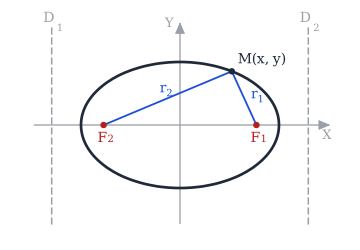
Ellipse with foci F₁, F₂, a point M(x,y) with focal radii r₁, r₂, and the directrices D₁, D₂.
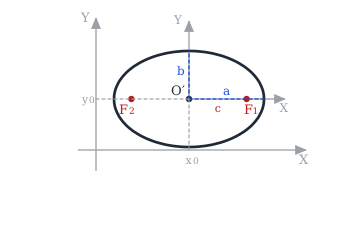
I.1 Translated Ellipse
(xx0)2a2+(yy0)2b2=1;O(x0,y0) — centre.\frac{(x-x_0)^2}{a^2}+\frac{(y-y_0)^2}{b^2}=1;\qquad O'(x_0,y_0)\ \text{— centre.}

1) a>b, c=a2b2, F1(x0+c;y0), F2(x0c;y0)a>b,\ c=\sqrt{a^2-b^2},\ F_1(x_0+c;\,y_0),\ F_2(x_0-c;\,y_0);

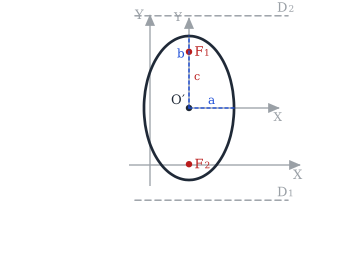
2) a<b, c=b2a2, F1(x0;y0+c), F2(x0;y0c)a<b,\ c=\sqrt{b^2-a^2},\ F_1(x_0;\,y_0+c),\ F_2(x_0;\,y_0-c).

Ellipse a>b, centre O′(x₀,y₀), semi-axes a, b, distance c to the foci F₁, F₂, shifted axes X′, Y′.
I.2 Eccentricity
(xx0)2a2+(yy0)2b2=1.\frac{(x-x_0)^2}{a^2}+\frac{(y-y_0)^2}{b^2}=1.

1) a>b; ε=ca=a2b2aa>b;\ \varepsilon=\dfrac{c}{a}=\dfrac{\sqrt{a^2-b^2}}{a} — eccentricity;

2) a<b; ε=cb=b2a2ba<b;\ \varepsilon=\dfrac{c}{b}=\dfrac{\sqrt{b^2-a^2}}{b} — eccentricity.

Ellipse b>a, foci on the vertical axis, horizontal directrices D₁, D₂.
I.3 Equations of the Directrices

1) a>ba>b: D2: x=x0+aε;D1: x=x0aε\quad D_2:\ x=x_0+\dfrac{a}{\varepsilon};\qquad D_1:\ x=x_0-\dfrac{a}{\varepsilon};

2) b>ab>a: D2: y=y0+bε;D1: y=y0bε\quad D_2:\ y=y_0+\dfrac{b}{\varepsilon};\qquad D_1:\ y=y_0-\dfrac{b}{\varepsilon}.

Hyperbola
II Definition and Canonical Equation

Definition. A hyperbola is the set of points of the plane, the absolute value of the difference of whose distances to two given points — called the foci — is a constant (denoted by 2a2a); moreover this constant is less than the distance between the foci.

If the foci of the hyperbola are placed at the points F1(c;0)F_1(c;0) and F2(c;0)F_2(-c;0), one obtains the canonical equation of the hyperbola

x2a2y2b2=1,whereb2=c2a2.\frac{x^2}{a^2}-\frac{y^2}{b^2}=1,\qquad\text{where}\quad b^2=c^2-a^2.

The points A1(a;0)A_1(a;0) and A2(a;0)A_2(-a;0) are called the vertices of the hyperbola. The segment A1A2A_1A_2 with A1A2=2a|A_1A_2|=2a is called the real (transverse) axis of the hyperbola, and the segment B1B2B_1B_2 with B1B2=2b|B_1B_2|=2b the imaginary (conjugate) axis.

The hyperbola has two asymptotes, whose equations are

y=±bax.y=\pm\frac{b}{a}\,x.

The ratio ε=ca>1\varepsilon=\dfrac{c}{a}>1 is called the eccentricity of the hyperbola.

The equation y2b2x2a2=1\dfrac{y^2}{b^2}-\dfrac{x^2}{a^2}=1 is also an equation of a hyperbola, but the real axis of this hyperbola is the segment of the OyOy axis of length 2b2b.

The two hyperbolas x2a2y2b2=1\dfrac{x^2}{a^2}-\dfrac{y^2}{b^2}=1 and y2b2x2a2=1\dfrac{y^2}{b^2}-\dfrac{x^2}{a^2}=1 have the same semi-axes and the same asymptotes, but the real axis of one serves as the imaginary axis of the other and vice versa. Such two hyperbolas are called conjugate.

The lines D1: x=aεD_1:\ x=-\dfrac{a}{\varepsilon} and D2: x=+aεD_2:\ x=+\dfrac{a}{\varepsilon}, perpendicular to the real axis and passing at distance aε\dfrac{a}{\varepsilon} from the centre, are called the directrices of the hyperbola.
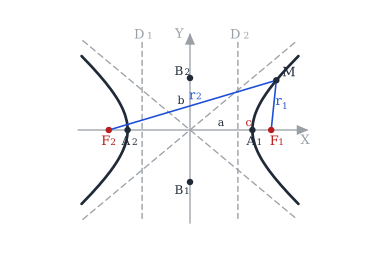
Hyperbola with vertices A₁, A₂, imaginary-axis points B₁, B₂, foci F₁, F₂, focal radii r₁, r₂, asymptotes and directrices D₁, D₂.
II.1 Translated Hyperbola

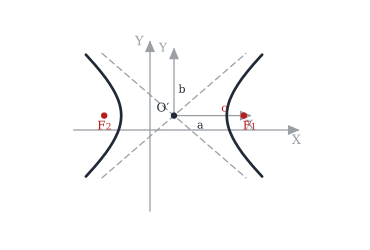
1) (xx0)2a2(yy0)2b2=1; O(x0;y0)\dfrac{(x-x_0)^2}{a^2}-\dfrac{(y-y_0)^2}{b^2}=1;\ O'(x_0;y_0) — centre, c=a2+b2c=\sqrt{a^2+b^2}, F1(x0+c;y0)F_1(x_0+c;\,y_0), F2(x0c;y0)F_2(x_0-c;\,y_0);

Horizontal hyperbola, centre O′(x₀,y₀), semi-axes a, b, foci F₁, F₂, asymptotes.

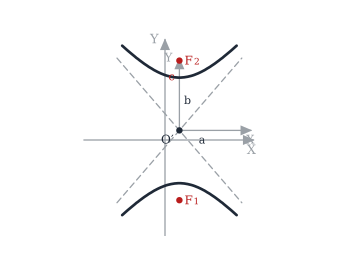
2) (yy0)2b2(xx0)2a2=1; O(x0;y0)\dfrac{(y-y_0)^2}{b^2}-\dfrac{(x-x_0)^2}{a^2}=1;\ O'(x_0;\,y_0) — centre, c=a2+b2c=\sqrt{a^2+b^2}, F1(x0;y0c)F_1(x_0;\,y_0-c), F2(x0;y0+c)F_2(x_0;\,y_0+c).

Vertical hyperbola, centre O′, foci F₁, F₂ on the vertical axis, asymptotes.
II.2 Eccentricity

1) (xx0)2a2(yy0)2b2=1; ε=ca=a2+b2a\dfrac{(x-x_0)^2}{a^2}-\dfrac{(y-y_0)^2}{b^2}=1;\ \varepsilon=\dfrac{c}{a}=\dfrac{\sqrt{a^2+b^2}}{a} — eccentricity.

2) (yy0)2b2(xx0)2a2=1; ε=cb=a2+b2b\dfrac{(y-y_0)^2}{b^2}-\dfrac{(x-x_0)^2}{a^2}=1;\ \varepsilon=\dfrac{c}{b}=\dfrac{\sqrt{a^2+b^2}}{b} — eccentricity.

II.3 Equations of the Directrices

1) (xx0)2a2(yy0)2b2=1,\dfrac{(x-x_0)^2}{a^2}-\dfrac{(y-y_0)^2}{b^2}=1,

D2: x=x0+aε;D1: x=x0aε;D_2:\ x=x_0+\dfrac{a}{\varepsilon};\qquad D_1:\ x=x_0-\dfrac{a}{\varepsilon};

2) (yy0)2b2(xx0)2a2=1,\dfrac{(y-y_0)^2}{b^2}-\dfrac{(x-x_0)^2}{a^2}=1,

D2: y=y0+bε;D1: y=y0bε.D_2:\ y=y_0+\dfrac{b}{\varepsilon};\qquad D_1:\ y=y_0-\dfrac{b}{\varepsilon}.
II.4 Equation of the Asymptotes
yy0=±b(xx0)a— equation of the asymptotes of the hyperbola.y-y_0=\pm\frac{b\,(x-x_0)}{a}\qquad\text{— equation of the asymptotes of the hyperbola.}
Parabola
III Definition and Canonical Equation

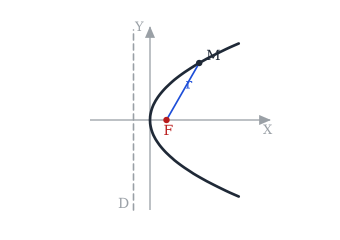
Definition. A parabola is the set of points of the plane equidistant from a given point — called the focus — and a given line — called the directrix.

If the directrix of the parabola is the line D: x=p2D:\ x=-\dfrac{p}{2}, and the focus is the point F(p2;0)F\left(\dfrac{p}{2};\,0\right), then the equation of the parabola has the form
y2=2px,wherep>0.y^2=2px,\qquad\text{where}\quad p>0.
Parabola y²=2px with focus F, a point M, focal radius r and the directrix D.
III.1 Translated Parabola

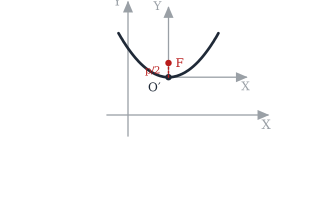
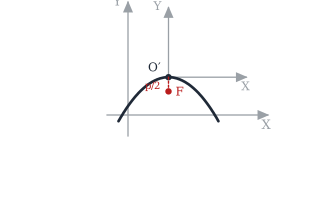
1) (xx0)2=2p(yy0); O(x0,y0)(x-x_0)^2=2p(y-y_0);\ O'(x_0,y_0) — vertex, p>0, F(x0,y0+p2)p>0,\ F(x_0,\,y_0+\tfrac{p}{2}) or p<0, F(x0,y0+p2)p<0,\ F(x_0,\,y_0+\tfrac{p}{2}).

Upward parabola (p>0), vertex O′, focus F at distance p/2.
Downward parabola (p<0), vertex O′, focus F.

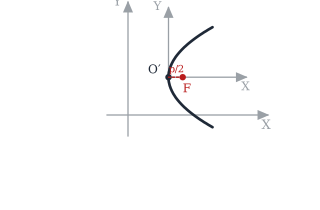
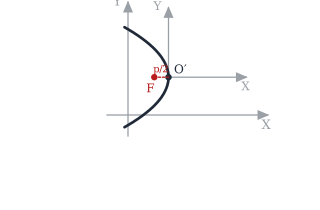
2) (yy0)2=2p(xx0); O(x0,y0)(y-y_0)^2=2p(x-x_0);\ O'(x_0,y_0) — vertex, p>0, F(x0+p2,y0)p>0,\ F(x_0+\tfrac{p}{2},\,y_0) or p<0, F(x0+p2,y0)p<0,\ F(x_0+\tfrac{p}{2},\,y_0).

Rightward parabola (p>0), vertex O′, focus F.
Leftward parabola (p<0), vertex O′, focus F.
III.2 Equation of the Directrix

1) (xx0)2=2p(yy0),(x-x_0)^2=2p(y-y_0),

p>0  D: y=y0p2,p<0  D: y=y0p2;p>0\ \ D:\ y=y_0-\dfrac{p}{2},\qquad p<0\ \ D:\ y=y_0-\dfrac{p}{2};

2) (yy0)2=2p(xx0),(y-y_0)^2=2p(x-x_0),

p>0  D: x=x0p2,p<0  D: x=x0p2.p>0\ \ D:\ x=x_0-\dfrac{p}{2},\qquad p<0\ \ D:\ x=x_0-\dfrac{p}{2}.
Axis-Aligned Second-Order Curves
IV.1 Classifying an Axis-Aligned Conic Using ACAC

For an axis-aligned second-order curve, the equation has the form Ax2+Cy2+2Dx+2Ey+F=0Ax^2+Cy^2+2Dx+2Ey+F=0. Because there is no xyxy term, the coordinate axes are aligned with the principal directions of the quadratic part. The sign of ACAC identifies the broad family: AC>0AC>0 is elliptic type, AC<0AC<0 is hyperbolic type, and AC=0AC=0 is parabolic type. This sign alone does not determine whether the curve is degenerate or whether it has real points; completing the square is still required.

IV.2 Completing the Square

In the investigation of second-order curves whose equation is written in general form, the “procedure of completing the square” is useful. This reduction assumes A0A\neq0 and C0C\neq0 (a central conic); the case AC=0AC=0 is treated in IV.2 (c). Completing the square of the equation Ax2+Cy2+2Dx+2Ey+F=0Ax^2+Cy^2+2Dx+2Ey+F=0, we obtain

A ⁣(x2+2DAx)+C ⁣(y2+2ECy)+F=0A\!\left(x^2+2\frac{D}{A}x\right)+C\!\left(y^2+2\frac{E}{C}y\right)+F=0

or

A ⁣(x+DA)2+C ⁣(y+EC)2=D2A+E2CF.A\!\left(x+\frac{D}{A}\right)^2+C\!\left(y+\frac{E}{C}\right)^2=\frac{D^2}{A}+\frac{E^2}{C}-F.

Denote x0=DA, y0=ECx_0=-\dfrac{D}{A},\ y_0=-\dfrac{E}{C}, and write R=D2A+E2CFR=\dfrac{D^2}{A}+\dfrac{E^2}{C}-F for the right-hand side, so that

A(xx0)2+C(yy0)2=R,a2=RA,b2=RC.A(x-x_0)^2+C(y-y_0)^2=R,\qquad a^2=\dfrac{R}{A},\qquad b^2=\dfrac{R}{C}.
IV.2 (a) Elliptic Type (AC>0)(AC>0)

If AC>0AC>0, the equation defines a curve of elliptic type. Since AC>0AC>0, a2=RAa^2=\dfrac{R}{A} and b2=RCb^2=\dfrac{R}{C} have the same sign. Then:

a) if RA<0\dfrac{R}{A}<0 (so a2<0a^2<0), we have an imaginary ellipse (no real points);

b) if R=0R=0, we have the single point (DA;EC)\left(-\dfrac{D}{A};\,-\dfrac{E}{C}\right);

c) if RA>0\dfrac{R}{A}>0, then

(xx0)2a2+(yy0)2b2=1,\frac{(x-x_0)^2}{a^2}+\frac{(y-y_0)^2}{b^2}=1,

the canonical form of an ellipse.

The test is the sign of R/AR/A, not of RR: when A,C<0A,C<0, multiplying the equation by 1-1 first makes A,C>0A,C>0 and reverses the sign of RR, giving the same answer. For example x2y2+1=0-x^2-y^2+1=0 has R=1R=-1 but R/A=1R/A=1 — the real unit circle.

IV.2 (b) Hyperbolic Type (AC<0)(AC<0)

If AC<0AC<0, the equation defines a curve of hyperbolic type. From completing the square, A(xx0)2+C(yy0)2=RA(x-x_0)^2+C(y-y_0)^2=R. Since AC<0AC<0, R/AR/A and R/CR/C have opposite signs, so a2a^2 and b2b^2 cannot both be taken positive — work from this form directly:

a) if R0R\neq0, divide by RR; the two terms then have opposite signs, and writing the positive term first gives

(xx0)2R/A(yy0)2R/C=1or(yy0)2R/C(xx0)2R/A=1,\frac{(x-x_0)^2}{|R/A|}-\frac{(y-y_0)^2}{|R/C|}=1\quad\text{or}\quad\frac{(y-y_0)^2}{|R/C|}-\frac{(x-x_0)^2}{|R/A|}=1,

the canonical form of a hyperbola;

b) if R=0R=0, then A(xx0)2+C(yy0)2=0A(x-x_0)^2+C(y-y_0)^2=0 with AC<0AC<0 splits into a pair of intersecting lines yy0=±A/C(xx0)y-y_0=\pm\sqrt{-A/C}\,(x-x_0).

IV.2 (c) Parabolic Type

If AC=0AC=0 and exactly one of AA, CC is nonzero, the quadratic part is a single perfect square; if A=C=0A=C=0 there is no quadratic term and the equation is linear (case (c) below). A single square gives a parabola only when the matching linear term is present as well:

a) if C=0C=0 with A0A\neq0 and E0E\neq0, then Ax2+2Dx+2Ey+F=0Ax^2+2Dx+2Ey+F=0 is a non-degenerate parabola. Completing the square:

A ⁣(x+DA)2=2E ⁣(y+D2AF2E).A\!\left(x+\frac{D}{A}\right)^2=-2E\!\left(y+\frac{\dfrac{D^2}{A}-F}{-2E}\right).

Denote x0=DA, y0=FD2A2E, p=EAx_0=-\dfrac{D}{A},\ y_0=-\dfrac{F-\dfrac{D^2}{A}}{2E},\ p=-\dfrac{E}{A}; then (xx0)2=2p(yy0)(x-x_0)^2=2p(y-y_0), the canonical form of a parabola. If instead E=0E=0, the equation reduces to A(x+DA)2=D2AFA\left(x+\dfrac{D}{A}\right)^2=\dfrac{D^2}{A}-F: two parallel lines, one repeated line, or no real points, according to the sign of D2/AFA\dfrac{D^2/A-F}{A};

b) if A=0A=0 with C0C\neq0 and D0D\neq0, symmetrically:

C ⁣(y+EC)2=2D ⁣(x+FE2C2D).C\!\left(y+\frac{E}{C}\right)^2=-2D\!\left(x+\frac{F-\dfrac{E^2}{C}}{2D}\right).

Denote x0=FE2C2D, y0=EC, p=DCx_0=-\dfrac{F-\dfrac{E^2}{C}}{2D},\ y_0=-\dfrac{E}{C},\ p=-\dfrac{D}{C}; then (yy0)2=2p(xx0)(y-y_0)^2=2p(x-x_0). If instead D=0D=0, the equation reduces to C(y+EC)2=E2CFC\left(y+\dfrac{E}{C}\right)^2=\dfrac{E^2}{C}-F: two parallel lines, one repeated line, or no real points;

c) if A=C=0A=C=0, the equation 2Dx+2Ey+F=02Dx+2Ey+F=0 is of the first degree — a single line, or (when D=E=0D=E=0) the empty set or the whole plane, not a conic.

Incomplete Equations of Curves
V.1 Equations of the Form y=b+ax2+cx+dy=b+\sqrt{ax^2+cx+d}

Consider an equation of the form y=b+ax2+cx+dy=b+\sqrt{ax^2+cx+d}. This equation is equivalent to the system

{yb0(yb)2=ax2+cx+d{yb(yb)2a ⁣(x+c2a)2=dc24a.\begin{cases} y-b\ge 0\\ (y-b)^2=ax^2+cx+d\end{cases}\sim\begin{cases} y\ge b\\ (y-b)^2-a\!\left(x+\dfrac{c}{2a}\right)^2=d-\dfrac{c^2}{4a}.\end{cases}

The completed-square form on the right assumes a0a\neq0; the case a=0a=0 is (e) below.

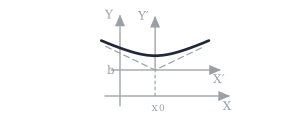
V.1 (a). If dc24a>0d-\dfrac{c^2}{4a}>0 and a>0a>0, the equation (yb)2a(x+c2a)2=dc24a(y-b)^2-a\left(x+\tfrac{c}{2a}\right)^2=d-\tfrac{c^2}{4a} defines the part of a hyperbola lying in the half-plane yby\ge b. We construct the part of the hyperbola above the line y=by=b.

Part of a hyperbola (upper branch) lying above the line y=b.

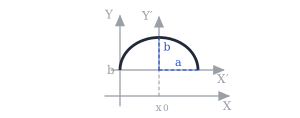
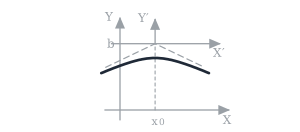
V.1 (b). If dc24a>0d-\dfrac{c^2}{4a}>0 and a<0a<0, the equation defines the part of an ellipse lying in the half-plane yby\ge b. We construct the part of the ellipse above the line y=by=b.

Upper half of an ellipse lying above the line y=b.

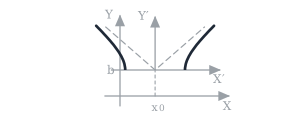
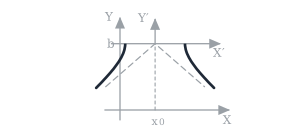
V.1 (c). If dc24a<0d-\dfrac{c^2}{4a}<0 and a>0a>0, the equation defines the part of a hyperbola lying in the half-plane yby\ge b.

Two upper arcs of a hyperbola lying above the line y=b.

V.1 (d). If dc24a<0d-\dfrac{c^2}{4a}<0 and a<0a<0, the equation defines an imaginary ellipse.

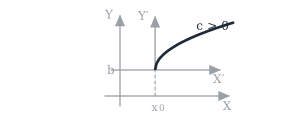
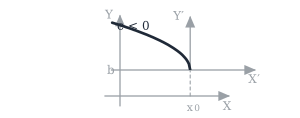
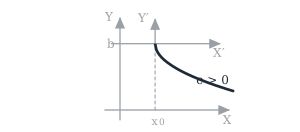
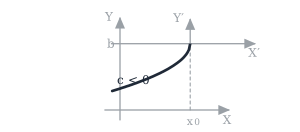
V.1 (e). If a=0a=0 and c0c\neq0, the equation y=b+cx+dy=b+\sqrt{cx+d} is equivalent to {yb0(yb)2=c(x+dc)\begin{cases}y-b\ge 0\\ (y-b)^2=c\left(x+\tfrac{d}{c}\right)\end{cases}, which defines the part of a parabola lying in the half-plane yby\ge b. If a=c=0a=c=0, the equation reads y=b+dy=b+\sqrt{d}: the horizontal line y=b+dy=b+\sqrt{d} when d0d\ge0, and no real points when d<0d<0.

Part of a parabola (c>0) above the line y=b.
Part of a parabola (c<0) above the line y=b.

V.1 (f). If dc24a=0d-\dfrac{c^2}{4a}=0 and a>0a>0, then (yb)2=a(x+c2a)2(y-b)^2=a\left(x+\tfrac{c}{2a}\right)^2; together with yby\ge b this gives yb=ax+c2ay-b=\sqrt{a}\,\bigl|x+\tfrac{c}{2a}\bigr| — the two rays in the half-plane yby\ge b that are the upper halves of the lines yb=±a(x+c2a)y-b=\pm\sqrt{a}\left(x+\tfrac{c}{2a}\right), meeting at (c2a;b)\left(-\tfrac{c}{2a};\,b\right).

V.1 (g). If dc24a=0d-\dfrac{c^2}{4a}=0 and a<0a<0, the equation defines the point (c2a;b)\left(-\tfrac{c}{2a};\,b\right), provided it lies in the half-plane yby\ge b.

V.2 Equations of the Form y=bax2+cx+dy=b-\sqrt{ax^2+cx+d}

Consider an equation of the form y=bax2+cx+dy=b-\sqrt{ax^2+cx+d}. This equation is equivalent to the system

{yb0(yb)2a ⁣(x+c2a)2=dc24a,\begin{cases} y-b\le 0\\ (y-b)^2-a\!\left(x+\dfrac{c}{2a}\right)^2=d-\dfrac{c^2}{4a},\end{cases}

since the principal square root is nonnegative. The completed-square form assumes a0a\neq0; the case a=0a=0 is (e) below.

V.2 (a). If dc24a>0d-\dfrac{c^2}{4a}>0 and a>0a>0, the equation defines the part of a hyperbola lying in the half-plane yby\le b.

Part of a hyperbola (lower branch) lying below the line y=b.

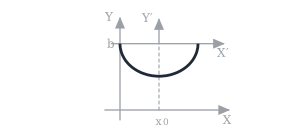
V.2 (b). If dc24a>0d-\dfrac{c^2}{4a}>0 and a<0a<0, the equation defines the part of an ellipse lying in the half-plane yby\le b.

Lower half of an ellipse lying below the line y=b.

V.2 (c). If dc24a<0d-\dfrac{c^2}{4a}<0 and a>0a>0, the equation defines the part of a hyperbola lying in the half-plane yby\le b.

Two lower arcs of a hyperbola lying below the line y=b.

V.2 (d). If dc24a<0d-\dfrac{c^2}{4a}<0 and a<0a<0, the equation defines an imaginary ellipse.

V.2 (e). If a=0a=0 and c0c\neq0, the equation y=bcx+dy=b-\sqrt{cx+d} is equivalent to {yb(yb)2=c(x+dc)\begin{cases}y\le b\\ (y-b)^2=c\left(x+\tfrac{d}{c}\right)\end{cases}, which defines the part of a parabola lying in the half-plane yby\le b. If a=c=0a=c=0, the equation reads y=bdy=b-\sqrt{d}: the horizontal line y=bdy=b-\sqrt{d} when d0d\ge0, and no real points when d<0d<0.

Part of a parabola (c>0) below the line y=b.
Part of a parabola (c<0) below the line y=b.

V.2 (f). If dc24a=0d-\dfrac{c^2}{4a}=0 and a>0a>0, then (yb)2=a(x+c2a)2(y-b)^2=a\left(x+\tfrac{c}{2a}\right)^2; together with yby\le b this gives yb=ax+c2ay-b=-\sqrt{a}\,\bigl|x+\tfrac{c}{2a}\bigr| — the two rays in the half-plane yby\le b that are the lower halves of the lines yb=±a(x+c2a)y-b=\pm\sqrt{a}\left(x+\tfrac{c}{2a}\right), meeting at (c2a;b)\left(-\tfrac{c}{2a};\,b\right).

V.2 (g). If dc24a=0d-\dfrac{c^2}{4a}=0 and a<0a<0, the equation defines the point (c2a;b)\left(-\tfrac{c}{2a};\,b\right), provided it lies in the half-plane yby\le b.