 MathForma
Basic Definitions
I.1 Components of a Vector
If a vector has Cartesian rectangular coordinates , then
If a vector is given by its initial point and terminal point , then the coordinates of this vector equal the differences of the like coordinates of the end and the start:
The zero vector is a vector whose start and end coincide. It has magnitude zero and no defined direction.
I.2 Sum and Difference of Vectors
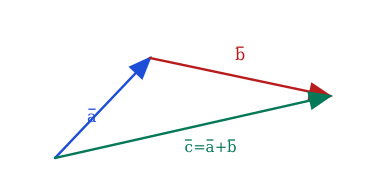
Sum. The sum of two vectors is built either by the triangle rule (place them head to tail) or by the parallelogram rule (draw them from a common origin).
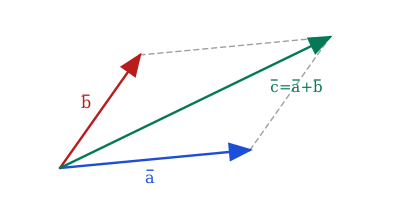
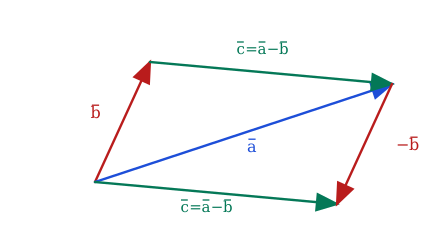
Difference. The difference is the other diagonal of the parallelogram built on and .
If and , then
If and , then
I.3 Magnitude of a Vector
If , the magnitude (length) of the vector in an orthonormal basis is
Since
we have . The direction cosines of a nonzero vector are the coordinates of its unit vector:
The zero vector has no direction, hence no direction cosines and no unit vector.
I.4 Scalar Product of Vectors
Definition. The scalar product (dot product) of two vectors is the number equal to the product of their lengths and the cosine of the angle between them:
Properties of the scalar product:
- — commutativity;
- — homogeneity (a scalar factor pulls out); the dot product is not associative, since is undefined;
- — distributivity;
- , or , or ;
- .
If and , then
I.4 (a) Length of
If , where and the angle between the vectors are known and , then
I.4 (b) Scalar Product of Two Combinations
If and , where and the angle are known and , then
I.4 (c) Angle Between Two Vectors
The angle between two nonzero vectors and is computed by the formula
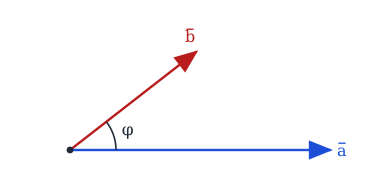
I.4 (d) Angle Between Two Vectors in Coordinates
If and are both nonzero, then
I.5 Vector Product of Vectors
Definition. The vector product (cross product) of a vector by a vector is the vector satisfying the following conditions:
- ;
- ;
- the vector is directed so that, seen from its end, the shortest rotation from to is counterclockwise (the right-hand rule).
The vector product is denoted or . Conditions 2–3 fix a direction only when , i.e. when and are nonzero and non-parallel; otherwise (property 2 below).
Properties of the vector product:
- — anticommutative;
- if or , or ;
- — the scalar factor may be taken outside;
- — distributive over addition.
If and , then
I.5 (a) Area of a Triangle
The area of the triangle built on the vectors and is computed by the formula
I.5 (b) Vector Product of Two Combinations · Area of a Parallelogram
If and , where , then
since ; ; . The area of the parallelogram is
I.5 (c) A Vector Perpendicular to Two Vectors
The vector product is perpendicular to both and . If and are non-parallel, the vectors perpendicular to both form a line: every such satisfies . For and , one such vector is
or
where
When , the two unit vectors perpendicular to both and are .
I.6 Mixed Product of Three Vectors
Definition. The mixed product of vectors and is the scalar product of the vector with the vector , i.e. — also called the scalar triple product.
Properties of the mixed product:
- The mixed product equals zero if: (a) at least one of the factors is zero; (b) two of the factors are collinear (lie on parallel lines); (c) the three nonzero vectors are parallel to one and the same plane (coplanarity).
- The mixed product is unchanged when the dot and the cross are interchanged (without reordering the vectors): ; it is therefore written simply .
- It does not change under a cyclic permutation of the vectors: .
- Swapping any two vectors changes only its sign:
If ; ; , then
From these properties it follows that:
(a) the necessary and sufficient condition for the coplanarity of three vectors is , i.e.
(b) the volume of the parallelepiped built on and the volume of the triangular pyramid (tetrahedron) they form are found by the formulas , or
or
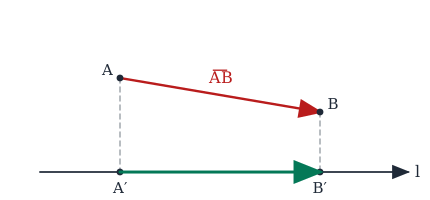
I.7 Scalar and Vector Projections
The projection of a vector onto an axis is the value of the directed segment enclosed between the projections of the start and the end of , taken with a positive sign when has the direction of the unit vector of the axis , and with a negative sign when and that unit vector have opposite directions. Let be any nonzero vector along the axis ; then