Basic Definitions

Plane
I (a) General Equation of a Plane

Every linear equation Ax+By+Cz+D=0Ax+By+Cz+D=0, with AA, BB, and CC not all zero, represents a plane; conversely, every plane has an equation of this form. Here A,B,CA,\,B,\,C are the coordinates of the normal vector:

n=Ai+Bj+Ck.\overline{n}=A\overline{i}+B\overline{j}+C\overline{k}.
I (b) Point-on-Plane Condition

A point M0(x0,y0,z0)M_0(x_0,y_0,z_0) lies on the plane A1x+B1y+C1z+D1=0A_1x+B_1y+C_1z+D_1=0 precisely when its coordinates satisfy the equation:

A1x0+B1y0+C1z0+D1=0.A_1x_0+B_1y_0+C_1z_0+D_1=0.
II Normal Equation of a Plane

The normal equation of a plane has the form

xcosα+ycosβ+zcosγp=0,x\cos\alpha+y\cos\beta+z\cos\gamma-p=0,

where cosα,cosβ,cosγ\cos\alpha,\,\cos\beta,\,\cos\gamma are the direction cosines of the unit normal and p0p\ge 0 is the distance from the origin to the plane. It is obtained from the general equation Ax+By+Cz+D=0Ax+By+Cz+D=0 by multiplying through by the normalising factor

μ=εA2+B2+C2,ε=±1 chosen so that εD0,\mu=\frac{\varepsilon}{\sqrt{A^2+B^2+C^2}},\qquad \varepsilon=\pm1\ \text{chosen so that}\ \varepsilon D\le 0,

i.e. the normalising factor is taken with the sign opposite to the free term DD. Then

cosα=μA,cosβ=μB,cosγ=μC,\cos\alpha=\mu A,\qquad \cos\beta=\mu B,\qquad \cos\gamma=\mu C,
p=μD=DA2+B2+C2.p=-\mu D=\frac{|D|}{\sqrt{A^2+B^2+C^2}}.
III (a) Intercept Form

The intercept form of the equation of a plane is

xa+yb+zc=1,\frac{x}{a}+\frac{y}{b}+\frac{z}{c}=1,

where a=DAa=-\dfrac{D}{A}, b=DBb=-\dfrac{D}{B}, c=DCc=-\dfrac{D}{C}. The numbers a,b,ca,\,b,\,c are respectively the abscissa, ordinate, and applicate (the xx-, yy- and zz-intercepts) of the points where the plane meets the coordinate axes. This form requires A,B,C,DA,\,B,\,C,\,D all nonzero; a plane through the origin or parallel to a coordinate axis has no such form.

III (b) Plane Through a Point with a Given Normal Vector

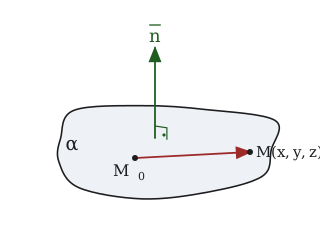
The equation of the plane passing through the point M0(x0,y0,z0)M_0(x_0,y_0,z_0) and perpendicular to the vector n=Ai+Bj+Ck\overline{n}=A\overline{i}+B\overline{j}+C\overline{k} has the form

A(xx0)+B(yy0)+C(zz0)=0,A(x-x_0)+B(y-y_0)+C(z-z_0)=0,

or, in vector form, (n,M0M)=0\bigl(\overline{n},\,\overline{M_0M}\bigr)=0.

Plane α with normal vector n through point M₀ and a generic point M(x,y,z)
III (c) Plane Through Three Points

The equation of the plane passing through three given non-collinear points M1(x1,y1,z1)M_1(x_1,y_1,z_1), M2(x2,y2,z2)M_2(x_2,y_2,z_2), M3(x3,y3,z3)M_3(x_3,y_3,z_3) has the form

xx1yy1zz1x2x1y2y1z2z1x3x1y3y1z3z1=0,\begin{vmatrix} x-x_1 & y-y_1 & z-z_1 \\ x_2-x_1 & y_2-y_1 & z_2-z_1 \\ x_3-x_1 & y_3-y_1 & z_3-z_1 \end{vmatrix}=0,

or, in vector form, as the vanishing of the mixed product (scalar triple product) (M1M2,  M1M3,  M1M)=0\bigl(\overline{M_1M_2},\;\overline{M_1M_3},\;\overline{M_1M}\bigr)=0. If the three points are collinear, M1M2\overline{M_1M_2} and M1M3\overline{M_1M_3} are proportional, the determinant vanishes for every (x,y,z)(x,y,z), and the points do not determine a unique plane.
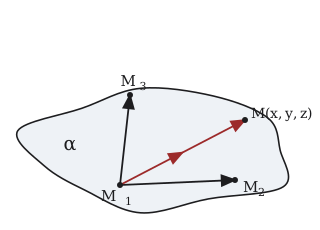
Plane α through three points M₁, M₂, M₃ and a generic point M(x,y,z)
III (d) Pencil of Planes

For an arbitrary value of the parameter λ\lambda, the equation

A1x+B1y+C1z+D1+λ(A2x+B2y+C2z+D2)=0A_1x+B_1y+C_1z+D_1+\lambda\,(A_2x+B_2y+C_2z+D_2)=0

defines a plane passing through the line of intersection of the planes

A1x+B1y+C1z+D1=0andA2x+B2y+C2z+D2=0.A_1x+B_1y+C_1z+D_1=0 \quad\text{and}\quad A_2x+B_2y+C_2z+D_2=0.

As λ\lambda runs over all real numbers this gives every plane of the pencil except the second plane A2x+B2y+C2z+D2=0A_2x+B_2y+C_2z+D_2=0 itself (its λ\lambda\to\infty limit). To include it, use the homogeneous form λ1(A1x+B1y+C1z+D1)+λ2(A2x+B2y+C2z+D2)=0\lambda_1(A_1x+B_1y+C_1z+D_1)+\lambda_2(A_2x+B_2y+C_2z+D_2)=0 with (λ1,λ2)(0,0)(\lambda_1,\lambda_2)\neq(0,0).

III (e) Condition for a Point to Lie on a Plane of the Pencil

Write Li(M0)=Aix0+Biy0+Ciz0+DiL_i(M_0)=A_ix_0+B_iy_0+C_iz_0+D_i. The condition for a point M0(x0,y0,z0)M_0(x_0,y_0,z_0) to lie on a plane of the pencil is

L1(M0)+λL2(M0)=0.L_1(M_0)+\lambda\,L_2(M_0)=0.

When L2(M0)0L_2(M_0)\neq0 this gives λM0=L1(M0)L2(M0)\lambda_{M_0}=-\dfrac{L_1(M_0)}{L_2(M_0)}. To avoid the division — and to cover L2(M0)=0L_2(M_0)=0, where the pencil plane through M0M_0 is the second plane L2=0L_2=0 itself — use the equivalent homogeneous equation of that plane:

L2(M0)(A1x+B1y+C1z+D1)L1(M0)(A2x+B2y+C2z+D2)=0.L_2(M_0)\,\bigl(A_1x+B_1y+C_1z+D_1\bigr)-L_1(M_0)\,\bigl(A_2x+B_2y+C_2z+D_2\bigr)=0.

If L1(M0)=L2(M0)=0L_1(M_0)=L_2(M_0)=0, the point M0M_0 lies on the base line and every plane of the pencil passes through it.

III (f) Plane Through a Point and a Line

The plane passing through the point M0(x0,y0,z0)M_0(x_0,y_0,z_0) and the line defined as the intersection of A1x+B1y+C1z+D1=0A_1x+B_1y+C_1z+D_1=0 and A2x+B2y+C2z+D2=0A_2x+B_2y+C_2z+D_2=0 is the pencil member through M0M_0 (assuming M0M_0 is not on the line). Using Li(M0)=Aix0+Biy0+Ciz0+DiL_i(M_0)=A_ix_0+B_iy_0+C_iz_0+D_i, it is

L2(M0)(A1x+B1y+C1z+D1)L1(M0)(A2x+B2y+C2z+D2)=0,L_2(M_0)\,\bigl(A_1x+B_1y+C_1z+D_1\bigr)-L_1(M_0)\,\bigl(A_2x+B_2y+C_2z+D_2\bigr)=0,

which for L2(M0)0L_2(M_0)\neq0 is the same as A1x+B1y+C1z+D1+λM0(A2x+B2y+C2z+D2)=0A_1x+B_1y+C_1z+D_1+\lambda_{M_0}\,(A_2x+B_2y+C_2z+D_2)=0 with λM0=L1(M0)/L2(M0)\lambda_{M_0}=-L_1(M_0)/L_2(M_0).

IV Angle Between Two Planes

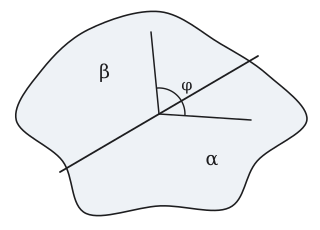
The angle φ\varphi between the planes A1x+B1y+C1z+D1=0A_1x+B_1y+C_1z+D_1=0 and A2x+B2y+C2z+D2=0A_2x+B_2y+C_2z+D_2=0 is determined by the formula

cosφ=A1A2+B1B2+C1C2A12+B12+C12A22+B22+C22,\cos\varphi=\frac{\left|A_1A_2+B_1B_2+C_1C_2\right|}{\sqrt{A_1^2+B_1^2+C_1^2}\,\sqrt{A_2^2+B_2^2+C_2^2}},

taking φ\varphi as the acute angle between the planes, where n1=(A1,B1,C1)\overline{n}_1=(A_1,B_1,C_1) and n2=(A2,B2,C2)\overline{n}_2=(A_2,B_2,C_2) are the plane normals. They are parallel (or coincident) when the normals are proportional,

n1×n2=0,\overline{n}_1\times\overline{n}_2=\overline{0},

perpendicular when

A1A2+B1B2+C1C2=0,A_1A_2+B_1B_2+C_1C_2=0,

and intersecting in a line when the normals are not proportional, n1×n20\overline{n}_1\times\overline{n}_2\neq\overline{0}.

Two intersecting planes α and β with the dihedral angle φ between them
V Signed Distance from a Point to a Plane

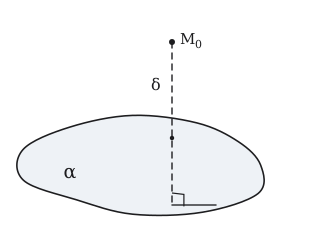
The signed distance (deviation) δ\delta of a point M0(x0,y0,z0)M_0(x_0,y_0,z_0) from the plane Ax+By+Cz+D=0Ax+By+Cz+D=0 is found by the formula

δ=Ax0+By0+Cz0+D±A2+B2+C2,\delta=\frac{Ax_0+By_0+Cz_0+D}{\pm\sqrt{A^2+B^2+C^2}},

where the sign before the radical is taken opposite to the sign of the free term DD. The (ordinary, nonnegative) distance from the point M0M_0 to the plane equals d=δd=|\delta|.

Plane α, an external point M₀, and the perpendicular deviation δ to the plane
Straight Line in Space
VI (a) Line Through Two Points

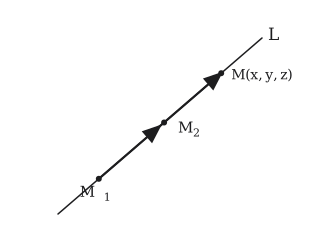
The equation of the straight line passing through two distinct points M1(x1,y1,z1)M_1(x_1,y_1,z_1) and M2(x2,y2,z2)M_2(x_2,y_2,z_2) has the form

xx1x2x1=yy1y2y1=zz1z2z1,\frac{x-x_1}{x_2-x_1}=\frac{y-y_1}{y_2-y_1}=\frac{z-z_1}{z_2-z_1},

where a zero denominator is read as the matching numerator being zero (e.g. x2=x1x_2=x_1 means the line lies in the plane x=x1x=x_1). Equivalently, in vector form — with no such restriction —

M1M=λM1M2,\overline{M_1M}=\lambda\,\overline{M_1M_2},

where M1M=(xx1,yy1,zz1)\overline{M_1M}=(x-x_1,\,y-y_1,\,z-z_1) and M1M2=(x2x1,y2y1,z2z1)\overline{M_1M_2}=(x_2-x_1,\,y_2-y_1,\,z_2-z_1).

Straight line L through points M₁, M₂ and a generic point M(x,y,z)
VI (b) Canonical Equation of a Line

The equation of the straight line passing through the point M1(x1,y1,z1)M_1(x_1,y_1,z_1) parallel to the vector S=li+mj+nk\overline{S}=l\overline{i}+m\overline{j}+n\overline{k} has the form

xx1l=yy1m=zz1n.\frac{x-x_1}{l}=\frac{y-y_1}{m}=\frac{z-z_1}{n}.

This is the canonical equation of the line — also called the symmetric form of the line; the nonzero vector S\overline{S} is called the direction vector of the line LL. A zero denominator is read as the matching numerator being zero (that coordinate is then constant); the parametric form VI (c) expresses the same line with no assumption on the components.
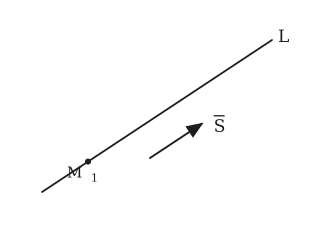
Straight line L through point M₁ parallel to the direction vector S
VI (c) Parametric Equations of a Line

The parametric equation of a straight line is

{x=lt+x1,y=mt+y1,z=nt+z1.\begin{cases} x=lt+x_1,\\ y=mt+y_1,\\ z=nt+z_1.\end{cases}

It is obtained from the canonical equation by introducing the parameter tt: setting xx1l=yy1m=zz1n=t\dfrac{x-x_1}{l}=\dfrac{y-y_1}{m}=\dfrac{z-z_1}{n}=t and solving each ratio for the corresponding coordinate. Unlike the canonical form, this holds for any direction vector S=(l,m,n)0\overline{S}=(l,m,n)\neq\overline{0}, including one with zero components.

VI (d) Line as the Intersection of Two Planes

A straight line in space can be defined by the equations of two planes:

{A1x+B1y+C1z+D1=0,A2x+B2y+C2z+D2=0,n1=(A1,B1,C1),  n2=(A2,B2,C2).\begin{cases} A_1x+B_1y+C_1z+D_1=0,\\ A_2x+B_2y+C_2z+D_2=0,\end{cases}\qquad \overline{n}_1=(A_1,B_1,C_1),\ \ \overline{n}_2=(A_2,B_2,C_2).

This is the general equation of a straight line, provided the planes actually meet in a line, i.e. n1×n20\overline{n}_1\times\overline{n}_2\neq\overline{0} (parallel distinct planes have no common line, and coincident planes do not determine a unique one). To bring it to canonical form:

1) Find a point MM on the line by fixing the coordinate whose complementary 2×22\times2 minor is nonzero — at least one such coordinate exists because n1×n20\overline{n}_1\times\overline{n}_2\neq\overline{0}. Fixing z=z0z=z_0 works when A1B1A2B20\begin{vmatrix} A_1 & B_1 \\ A_2 & B_2 \end{vmatrix}\neq0; then solve the system for the remaining two coordinates:

x0=C1z0D1B1C2z0D2B2A1B1A2B2,y0=A1C1z0D1A2C2z0D2A1B1A2B2.x_0=\frac{\begin{vmatrix} -C_1z_0-D_1 & B_1 \\ -C_2z_0-D_2 & B_2 \end{vmatrix}}{\begin{vmatrix} A_1 & B_1 \\ A_2 & B_2 \end{vmatrix}},\qquad y_0=\frac{\begin{vmatrix} A_1 & -C_1z_0-D_1 \\ A_2 & -C_2z_0-D_2 \end{vmatrix}}{\begin{vmatrix} A_1 & B_1 \\ A_2 & B_2 \end{vmatrix}}.

2) Find the direction vector S\overline{S}, parallel to the line (Sn1\overline{S}\perp\overline{n}_1 and Sn2\overline{S}\perp\overline{n}_2), as the vector product (cross product)

S=n1×n2=ijkA1B1C1A2B2C2=(B1C2B2C1)i+(A2C1A1C2)j+(A1B2A2B1)k=li+mj+nk.\overline{S}=\overline{n}_1\times\overline{n}_2=\begin{vmatrix} \overline{i} & \overline{j} & \overline{k} \\ A_1 & B_1 & C_1 \\ A_2 & B_2 & C_2 \end{vmatrix}=(B_1C_2-B_2C_1)\overline{i}+(A_2C_1-A_1C_2)\overline{j}+(A_1B_2-A_2B_1)\overline{k}=l\overline{i}+m\overline{j}+n\overline{k}.

Hence xx0l=yy0m=zz0n\dfrac{x-x_0}{l}=\dfrac{y-y_0}{m}=\dfrac{z-z_0}{n} — the canonical form of the line.

VI (e) From Canonical Form to Two Plane Equations

If a line is given by the canonical equation xx0l=yy0m=zz0n\dfrac{x-x_0}{l}=\dfrac{y-y_0}{m}=\dfrac{z-z_0}{n}, then the pair of equations

{xx0l=yy0m,yy0m=zz0n\begin{cases} \dfrac{x-x_0}{l}=\dfrac{y-y_0}{m},\\[6pt] \dfrac{y-y_0}{m}=\dfrac{z-z_0}{n}\end{cases}

defines the same line as the intersection of two planes. This split assumes l,m,nl,m,n are all nonzero; if one vanishes, keep its constant-coordinate equation instead — e.g. l=0l=0 gives x=x0x=x_0 together with yy0m=zz0n\dfrac{y-y_0}{m}=\dfrac{z-z_0}{n}.

VI (f) Angle Between Two Lines

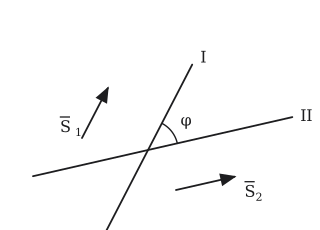
The angle between two lines in space, given by their canonical equations xx1l1=yy1m1=zz1n1\dfrac{x-x_1}{l_1}=\dfrac{y-y_1}{m_1}=\dfrac{z-z_1}{n_1} and xx2l2=yy2m2=zz2n2\dfrac{x-x_2}{l_2}=\dfrac{y-y_2}{m_2}=\dfrac{z-z_2}{n_2}, is determined by the formula

cosφ=l1l2+m1m2+n1n2l12+m12+n12l22+m22+n22,\cos\varphi=\frac{\left|l_1l_2+m_1m_2+n_1n_2\right|}{\sqrt{l_1^2+m_1^2+n_1^2}\,\sqrt{l_2^2+m_2^2+n_2^2}},

with φ\varphi the acute angle, where S1=(l1,m1,n1)\overline{S}_1=(l_1,m_1,n_1) and S2=(l2,m2,n2)\overline{S}_2=(l_2,m_2,n_2) are the (nonzero) direction vectors. The lines are parallel when the direction vectors are proportional,

S1×S2=0,\overline{S}_1\times\overline{S}_2=\overline{0},

and perpendicular when

l1l2+m1m2+n1n2=0.l_1l_2+m_1m_2+n_1n_2=0.
Two lines I and II crossing at angle φ, with direction vectors S₁ and S₂
VI (g) Condition for Two Lines to Be Coplanar

Two lines given by their canonical equations xx1l1=yy1m1=zz1n1\dfrac{x-x_1}{l_1}=\dfrac{y-y_1}{m_1}=\dfrac{z-z_1}{n_1} and xx2l2=yy2m2=zz2n2\dfrac{x-x_2}{l_2}=\dfrac{y-y_2}{m_2}=\dfrac{z-z_2}{n_2} are coplanar if and only if

x2x1y2y1z2z1l1m1n1l2m2n2=0.\begin{vmatrix} x_2-x_1 & y_2-y_1 & z_2-z_1 \\ l_1 & m_1 & n_1 \\ l_2 & m_2 & n_2 \end{vmatrix}=0.

If the numbers l1,m1,n1l_1,m_1,n_1 are not proportional to l2,m2,n2l_2,m_2,n_2, this coplanarity condition is the necessary and sufficient condition for the two lines to intersect.

VII Angle Between a Line and a Plane

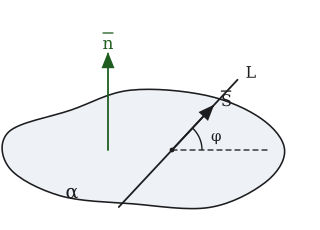
The angle between a line xx1l=yy1m=zz1n\dfrac{x-x_1}{l}=\dfrac{y-y_1}{m}=\dfrac{z-z_1}{n} and a plane Ax+By+Cz+D=0Ax+By+Cz+D=0 is determined by the formula

sinφ=Al+Bm+Cnl2+m2+n2A2+B2+C2,\sin\varphi=\frac{\left|Al+Bm+Cn\right|}{\sqrt{l^2+m^2+n^2}\,\sqrt{A^2+B^2+C^2}},

with φ\varphi the acute angle, where S={l,m,n}\overline{S}=\{l,m,n\} and n={A,B,C}\overline{n}=\{A,B,C\} are both nonzero. The line is parallel to the plane when

Al+Bm+Cn=0,Al+Bm+Cn=0,

and perpendicular to the plane when S\overline{S} and n\overline{n} are proportional,

S×n=0.\overline{S}\times\overline{n}=\overline{0}.
Line L piercing plane α at angle φ, showing the normal n and direction vector S
VIII Point of Intersection of a Line and a Plane

To find the point of intersection of a line xx0l=yy0m=zz0n\dfrac{x-x_0}{l}=\dfrac{y-y_0}{m}=\dfrac{z-z_0}{n} with a plane Ax+By+Cz+D=0Ax+By+Cz+D=0, write the line in parametric form

x=x0+lt,y=y0+mt,z=z0+nt,x=x_0+lt,\qquad y=y_0+mt,\qquad z=z_0+nt,

and substitute into the equation of the plane. From it we determine the parameter tt:

t=Ax0+By0+Cz0+DAl+Bm+Cn.t=-\frac{Ax_0+By_0+Cz_0+D}{Al+Bm+Cn}.

Substituting this value back into the parametric equations gives the coordinates x,y,zx,\,y,\,z of the intersection point.

  • If Al+Bm+Cn0Al+Bm+Cn\neq0, the line intersects the plane.
  • If Al+Bm+Cn=0Al+Bm+Cn=0 and Ax0+By0+Cz0+D0Ax_0+By_0+Cz_0+D\neq0, the line is parallel to the plane.
  • If Al+Bm+Cn=0Al+Bm+Cn=0 and Ax0+By0+Cz0+D=0Ax_0+By_0+Cz_0+D=0, the line lies in the plane.