 MathForma
Basic Definitions
I Division of a Segment in a Given Ratio
If two points and are given, the point that divides so that has coordinates
Here gives a point of the segment (internal division; is the midpoint), and gives a point on the line outside the segment (external division).
II General Equation of a Line
Every linear equation , with and not both zero, represents a line in the coordinate plane. This is called the general equation of a line. Particular cases:
- : the line passes through the origin.
- : the line is parallel to the axis (the -axis).
- : the line is parallel to the axis (the -axis).
- : the line coincides with the axis.
- : the line coincides with the axis.
III (a) Slope-Intercept Form
When (the line is not vertical) the equation can be written , where and . Here are the coefficients of the general equation of the line, and is the angle formed by the line with the positive -axis. The constant is the -coordinate of the -intercept. A vertical line () has no slope-intercept form.
III (b) Point-Slope Form
III (c) Two-Point Form of a Line
For two distinct points , the line is
i.e. . When and this is the same as
If the line is vertical, ; if it is horizontal, — both are covered by the determinant form above.
IV Intercept Form
An equation of the form
where and (with the coefficients of the general equation of the line), is called the equation of a line in intercept form. Here is the -intercept — where the line meets the -axis — and is the -intercept — where the line meets the -axis. This form requires all nonzero; a line through the origin or parallel to an axis has no such form.
V Normal Equation of a Line
An equation of the form
is called the normal equation of a line. Here is the length of the perpendicular dropped from the origin onto the line, and is the angle formed by this perpendicular with the positive direction of the axis.
To obtain the normal equation from the general equation , both sides are multiplied by the normalising factor
The sign before the radical is chosen so that . When (a line through the origin) and either sign gives a valid normal equation.
VI (a) Angle Between Two Lines — Slope Form
The acute angle between the lines and is found by the formula
The lines are parallel when , and perpendicular when .
VI (b) Angle Between Two Lines — General Form
If the lines are given by the equations and , the acute angle between them satisfies
The lines are parallel when , and perpendicular when — in the latter case the denominator vanishes and .
VII Intersection of Two Lines
The coordinates of the intersection point of and are found by solving the system
which gives
the solution being unique exactly when . Classifying by the minors of :
- : the lines intersect at one point.
- and not both zero: the lines are parallel.
- and : the lines coincide.
VIII (a) Signed Distance and Distance
The signed distance (deviation) of a point from the line is found by the formula
where the sign before the radical is chosen as in the normal equation (§V) — so that ; when , either choice is admissible and simply fixes which side of the line counts as positive. The (ordinary, nonnegative) distance from the point to the line then equals .
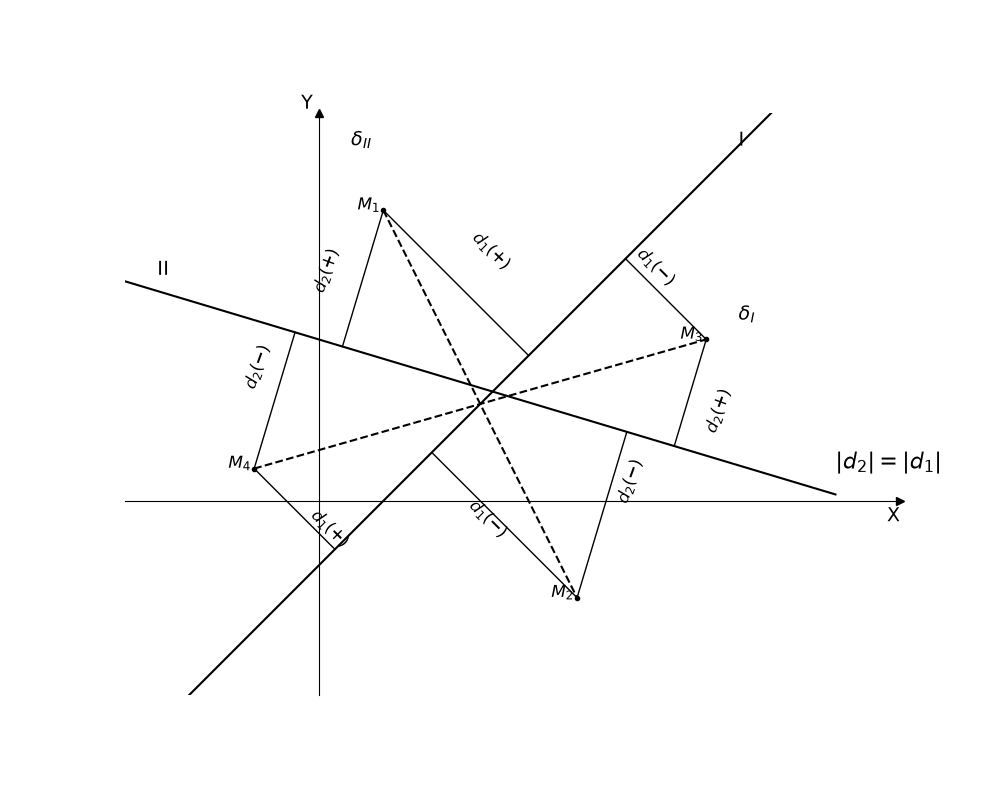
VIII (b) Bisectors of the Angles Between Two Lines
The choice of sign is made according to the figure: a point on a bisector is equidistant from both lines, .
IX Pencil of Lines
If two intersecting lines are given by the equations and , then the equation
defines a line passing through the point of intersection of the given lines. Here is a numerical parameter. As runs over all real numbers this gives every line of the pencil except the second line itself (its limit); to include it, use the homogeneous form with . The pencil's centre is the point of intersection of the given lines.